
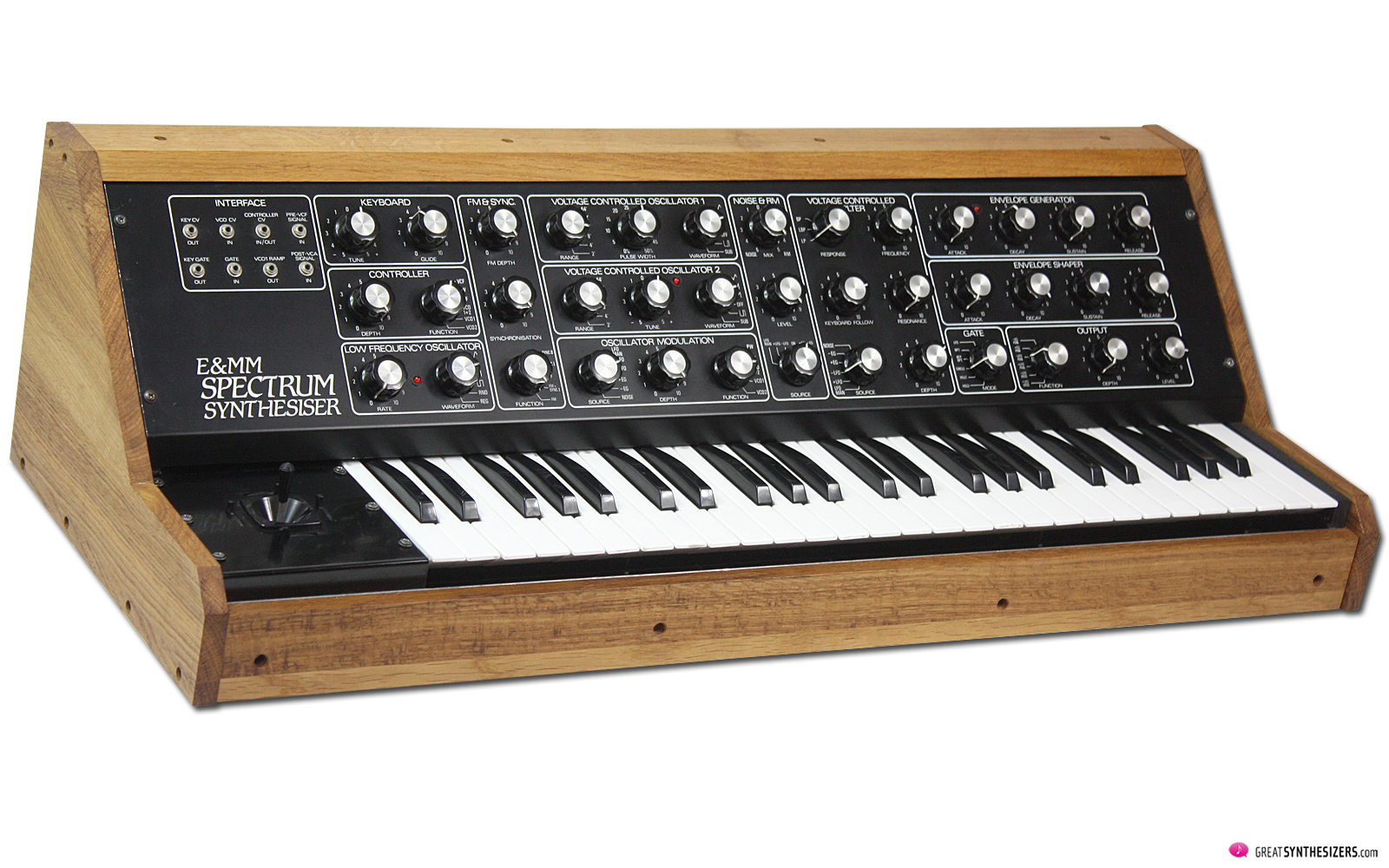
Featured in the UK magazine “Electronics & Music Maker,” the E&MM SPECTRUM SYNTHESISER was sold as a DIY synth only in 1981 and 1982. The kit contained all electronic and hardware components, including the front panel (plus – as we assume – a rear panel), a joystick, and the keyboard. Not included was the wooden housing, which meant that the DIY enthusiast had to pick up a saw himself (and do his best) … which is why the exterior of the SPECTRUM varies quite significantly from unit to unit.

Today, it is impossible to tell exactly how many of the kits distributed by the British DIY specialist Maplin were actually sold during 1981–82. The kits were reasonably priced at just over 200 pounds (i.e., affordable for a synthesizer with professional features), and soldering was all the rage in the 1980s … which strengthens the hope that the DIY initiative by E&MM / Maplin generated sufficient interest back in those days.

However, if we look at the current second-hand market, we see that SPECTRUM auctions continue to fetch surprisingly low prices even in the 21st century – mostly in the range of 200 to 900 pounds. Sure, a “do-it-yourself” synthesizer comes with a number of big question marks and doesn’t fetch collector’s prices, but anyone who has gotten to know the SPECTRUM is likely to immediately add this instrument – DIY or not – to their secret wish list.
The basis of the sound: CEM chips
While the DIY synth project was promoted by E&MM, the kits were supplied by Maplin, which delivered the circuit boards fully assembled. Only the ICs – the set of CEM chips needed to be purchased separately – had to be inserted into the sockets, and the solder points on the boards had to be wired to the switches …

… which means that the SPECTRUM’s circuit boards – which are obviously among the most critical components when it comes to sound quality – are generally in good condition.
“A professional front panel and ready made PCB’s were available from Maplin Electronics, whilst the CEM IC’s were available from Digisound. Being a DIY project, some examples are of excellent quality and others never made it off the bench!
The unit was a well specified 2 VCO switch routed synth with a few nice touches. The Spectrum is based around two CEM 3340 VCO’s (Curtis Electro Music), CEM 3320 filter, CEM 3330 VCA and CEM 3310 envelope generators.”
(source: bigbluewave.co.uk)

The use of the well-known CEM modules suggests that the SPECTRUM SYNTHESISER sounds similar to other vintage synthesizers with the same CEM-based DNA (e.g., Sequential Pro-One, Synton Syrinx, Roland SH-101, …). The fact that this is only partially true demonstrates just how crucial the specific PCB layout and sound architecture concept are in determining whether a given synthesizer ultimately develops its own distinct sonic character.
DIY aspects: hardware, reliability, and more
As already mentioned, it’s clear that the DIY construction of a SPECTRUM cannot be compared to the high-quality manufacturing standards of Roland, Korg, Yamaha, Sequential, etc. While the circuit boards themselves—at least in our unit—are clean and virtually exemplary in their construction (socketed ICs…), the cable connections, solder joints, and switches do not always leave the most trustworthy impression.

In our case, this means that the SPECTRUM functions flawlessly more than 90% of the time. Specific issues? The VCO octave switches are not in tune (calibration instructions are provided in the PDF attached below), the Output/Pan switch is permanently stuck in a certain position (-LFO PAN), many pots crackle (this can be fixed with Fader-Lube), and the keyboard in particular causes some glide and double-trigger effects. These are largely issues that are just as common with other vintage synthesizers.
A technician with an eye for detail could certainly fix the aforementioned issues with ease. Given the SPECTRUM’s musical sound, we would like to put the DIY challenges into perspective: What matters most is basic functionality and reliability, accurate octave alignment (keyboard and external CV), and a solid, strong audio signal. Since all these factors apply, the SPECTRUM—in such excellent condition—seems to us to be a thoroughly recommendable instrument.

Sonic architecture
The monophonic SPECTRUM SYNTHESISER features:
- 2 VCOs with sub-oscillators
- 1 multi-mode VCF (LP, LBP, BP)
- 2 ADSR envelopes (Env Gen, Env Shaper)
- 1 LFO (incl. Sample/Hold); 0.04 to 42 Hz
- Osc-Sync, continuously adjustable
- Linear FM, continuously adjustable
- Osc-Sync and FM can be combined
- Ring modulator and noise
- Volume of RM / noise can be modulated

- Filter envelope loop function
- Various gate modes, including LFO trigger / Envelope loop trigger / Hold
- Joystick with multiple freely assignable targets (X-axis)
- CV control of the joystick (and its targets)
- LFO MAN(ual) function of the joystick (Y-axis)
- Mono + stereo audio out with pan and AMP modulation
- CV/Gate IN/OUT, Controller CV IN/OUT, VCO1 RAMP OUT
- PRE-VCF and POST-VCF audio in
- Master TUNE and GLIDE
- 4-octave keyboard

The VCOs (CEM 3340)
With 6 waveforms each and pitch ranges from 64′ to 2′, both VCOs are generously equipped. Each features a sub-oscillator (which, when activated, produces a pulse wave “and” a square wave one octave lower). OSCILLATOR MODULATION can be done via LFO MAN (modulation depth adjustable forward/backward with the joystick), LFO (+/-), EG (+/-) and NOISE can affect either the pulse wave, VCO1+2, or just VCO1 or VCO2. Unfortunately the oscillators’ volumes cannot be adjusted … they’re either ON or OFF, that’s it.

In addition to the vast OSCILLATOR MODULATION, there is the option of linear FREQUENCY MODULATION (FM) as well as OSCILLATOR SYNCHRONIZATION in two variants (SYNC I / SYNC II). FM and SYNC can be blended continuously and used individually or in combination. Finally, the signal from NOISE or RING MODULATOR can be added and its volume modulated by LFO MAN, LFO (+/-), and EG (+/-). The two audio inputs mentioned above (PRE-VCF / POST-VCF) as well as the direct (unfiltered) VCO1 RAMP OUT signal round out the impressive range of audio sources.

The VCF (CEM 3320)
The filter uses a CEM 3320 IC, the same chip as found in the Elka Synthex. On the SPECTRUM, the filter offers LowPass, LowBandPass, and BandPass modes. Key tracking (referred to here as KEYBOARD FOLLOW) is continuously adjustable, and the filter frequency can once again be modulated by LFO MAN, LFO (+/-), EG (+/-), and NOISE, as well as by the joystick or an external CV voltage. One minor criticism: Since the LFO and the envelope are both part of the SOURCE options, you can only select one at a time … quite often, that’s not an easy decision.
The envelopes (CEM 3310)
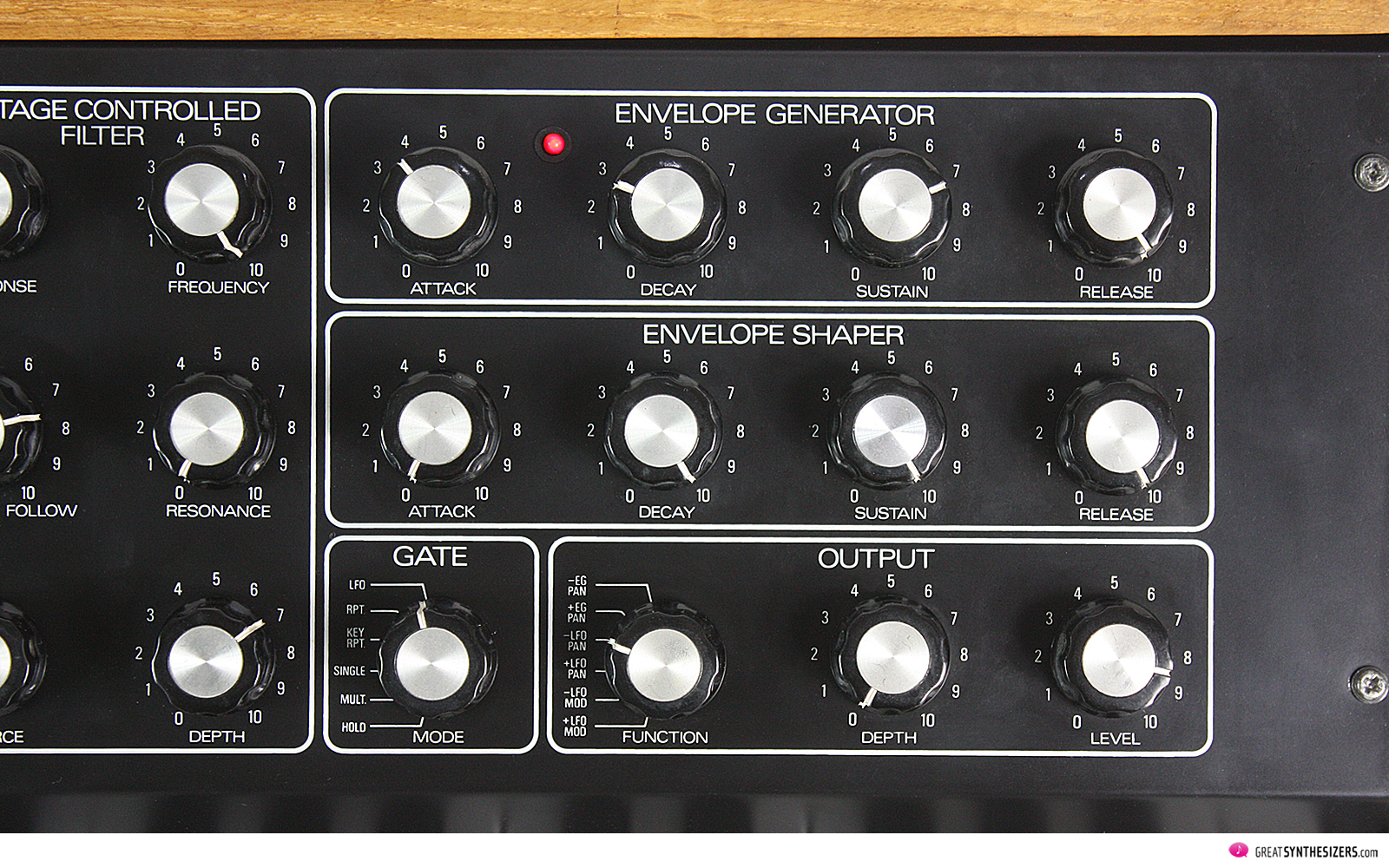
The filter envelope, also known as the ENVELOPE GENERATOR, is not only used to modulate the filter (and other modules); it also features an RPT (Repeat) function—i.e., LOOP—which can be enabled in the GATE section. Thus, living up to the name “Generator” (principle of rotational energy), a strict distinction is made here from the ENVELOPE SHAPER of the VCA(s) (CEM 3330). Finally, the signal from the now-activated stereo output module OUTPUT can be modulated in terms of panning and volume level via EG (+/-) or LFO (+/-). Very noble …

Sound: DNA of the EMS Synthi?
Our theory may never be confirmed, but it is striking nonetheless that the SPECTRUM SYNTHESISER shares DNA traits with the EMS Synthi, which also hails from England. Key features include the ENVELOPE GENERATOR (Loop-EG) and the joystick. Admittedly, the genetic makeup is more likely to come from other synthesizers by the kit manufacturer, such as the Maplin 4600 or 5600S, which, in addition to the joystick, were equipped with a pin header as the most striking reminder of the EMS Synthi.
In terms of sound, our take on EMS certainly hits the mark: The SPECTRUM SYNTHESISER is ideal for creating effects sounds and experimental soundscapes. The wide range of modulation options (LFO extending into the audio range, numerous modulation waveforms including S/H, linear FM, noise modulation, envelope with repeat function, volume and panning modulation, flexible CV input > e.g., VCO1 RAMP OUT to controller CV IN for cross-modulation, filter FM) make the Spectrum a top-notch synthesizer for FX sounds of all kinds.

A significant part of the expanded modulation capabilities stems from the availability of positive and negative modulation sources. A simple example is VCO control via the +LFO while the VCF and VCA are controlled by the -LFO. Simple, yet effective. Not to mention the MultiMode filter mentioned earlier, which features a very special filter type in its LowBandPass (LBP) mode.
Admittedly, the LBP isn’t as spectacular-sounding as its name might suggest, but the BandPass (BP) filter—just like the LowPass (LP) filter—is an extremely versatile tool for experimental sounds, especially at high resonance settings. If you set the resonance to zero in LowPass mode, the CEM-based sound architecture delivers bass sounds of the highest quality (here, the SPECTRUM, with 2 VCOs + 2 sub-oscillators, is almost on par with the recently introduced Oberheim OB-1).

The rich bass tones are certainly a treat for the ears, thanks in part to—here they are again—the percussive CEM 3310 envelopes. Lead sounds are top-notch, although playing on the—in our case—not entirely reliable keyboard somewhat dampens the enjoyment. (In fact, the SPECTRUM’s keyboard is repeatedly cited as a weak point in both literature and auctions, so it seems to be a fundamentally problematic issue.)
Speaking of synth literature: FM and SYNC are often cited as the SPECTRUM’s standout features. Indeed, their use is effective and, in some cases, quite unusual (the smooth, gradual blending of each function allows for a wide range of timbres, from coarse to very subtle). We would also like to mention the RING MODULATOR here, where turning the PULSE WIDTH knob on VCO1 results in a wonderful (subtle) change in the RM sound.

Furthermore, the SPECTRUM’s inputs and outputs on the panel are of great importance. On the one hand, they enable external CV/Gate control of the instrument (which significantly alleviates the tricky situation surrounding the keyboard); on the other hand, the CONTROLLER CV IN jack in particular can be seen as a small goldmine for FX sounds. This allows the VCF, PW, VCO1/2, or VCO1 and VCO2 separately to be modulated by external controllers—such as analog sequencers.
Above all, there is the simple fact that the SPECTRUM’s sound has a unique aura all its own. We don’t know why this is. The entire CEM architecture is completely standard, yet the sounds of the SPECTRUM are often (though not always) far from “standard”: lively, organic, voluminous (LP filter at low resonance), delicate (LBP filter at high resonance), sometimes uncontrollable (FM & SYNC), often surprising.

Secondhand market
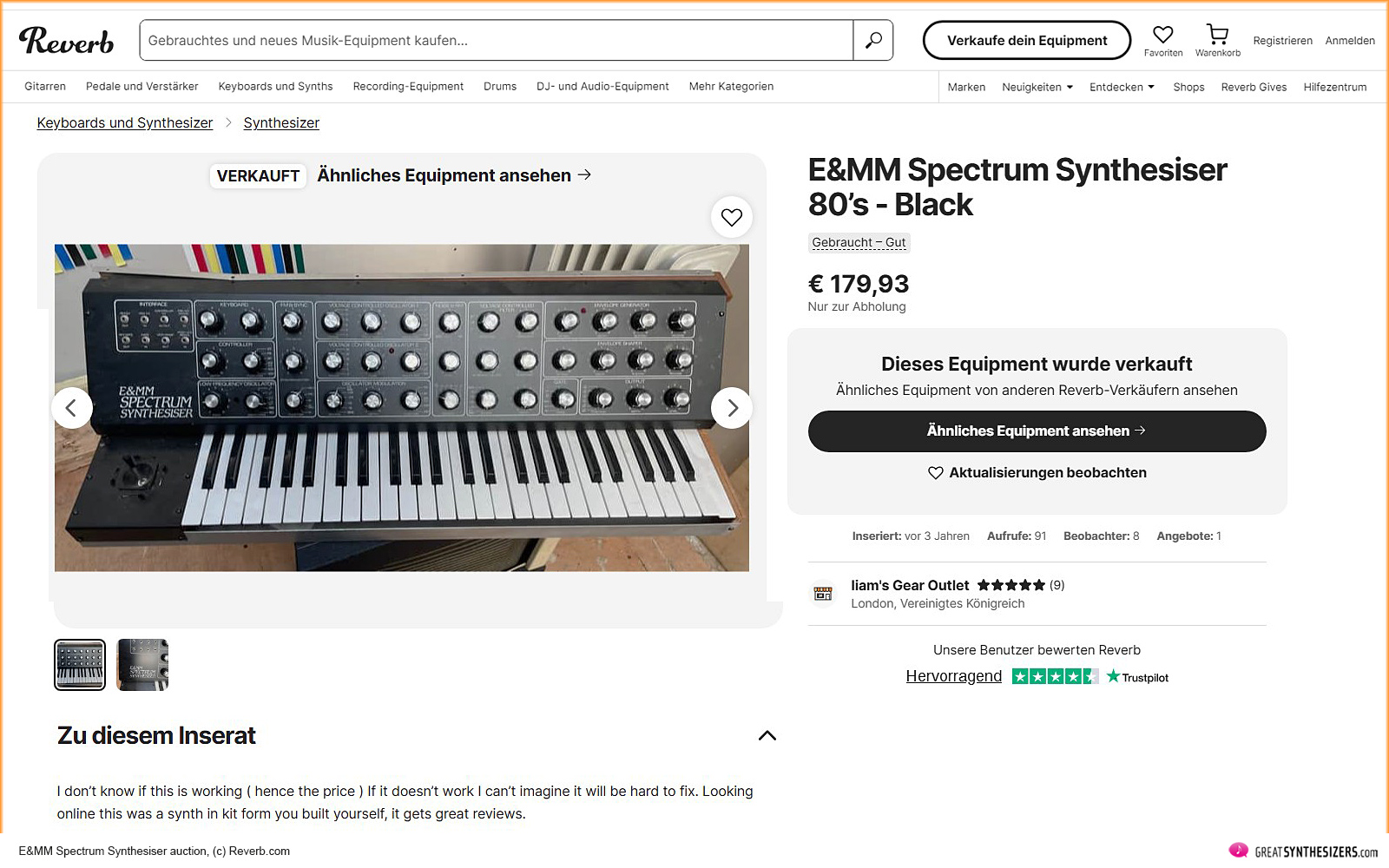
The SPECTRUM SYNTHESISER is a rare instrument that can occasionally be found on Reverb or Vemia. The chances of coming across a unit that works only partially are higher than the likelihood of finding a SPECTRUM in pristine condition. However, the schematics and lists of all components are available, which is why, with time and patience, almost any surviving SPECTRUM should be able to be restored to its former glory – both visually and sonically.
In many cases a complete overhaul of the internal components (including a new keyboard) might be the only sensible solution for a SPECTRUM SYNTHESISER in so-so condition. This means starting from scratch: getting the pots back in working order (or replacing them), re-soldering cables, etc. But the investment should be worth it, especially for musicians with a penchant for unusual tones and effects. Not many non-modular synthesizers (below the level of an EMS Synthi A or ARP 2600) are as enchanting as the SPECTRUM.
All in all
It has long been common knowledge among insiders that kit instruments from smaller synth manufacturers don’t necessarily sound any worse than professional instruments from major synth manufacturers. End of the 1970s, companies such as Elektor (Germany), ETI / Electronics Today International (Australia) and Maplin, as well as E&MM / Electronics & Music Maker (both UK), advertised and offered highly interesting synthesizers as kits: the Elektor Formant, the ETI 3600 / 4600 and the Maplin 3800 / 4600 / 5600S … just to name a few.
In the early 1980s, the E&MM SPECTRUM SYNTHESISER followed, which – provided it is in good working order and well-built, or has been successfully and properly refurbished – ranks among the most sonic versatile vintage synthesizers. Not quite in the same league as an EMS Synthi A or an ARP 2600, but almost …
In addition to the standard range of excellent analog sounds (basses, leads, etc.), it offers a whole array of unusual sounds and textures that – thanks in particular to its many specialized modulation options – give it a unique character. While the SPECTRUM may not be the most compelling choice in a modern high-end studio, it is sure to delight all those who are on the hunt for non-mainstream sounds. No surprise that the UK’s representative at the 2026 Eurovision Song Contest – Sam Battle, aka Look Mum No Computer – is so enthusiastic about the SPECTRUM SYNTHESISER.

x
As usual, over 40 minutes of sound samples are included. The recordings feature the SPECTRUM SYNTHESISER only. In addition to bass and sequencing patterns, the focus is primarily on all kinds of effects and modulation sounds. Once more, as usual …
E&MM SPECTRUM SYNTHESISER
Monophonic analog kit-synthesizer
(1981/1982)
Open / Download:
E&MM Spectrum pic front (4000 x 2200 px)
E&MM Spectrum pic back (4000 x 2200 px)
E&MM Spectrum description, schematics and parts lists (PDF, 47 pages)
E&MM Spectrum description, schematics and parts lists, with punch holes (PDF, 48 pages)
Links:
mu:zines THE SPECTRUM SYNTHESISER (by Chris Jordan), part 1
mu:zines THE SPECTRUM SYNTHESISER (by Chris Jordan), part 2
mu:zines THE SPECTRUM SYNTHESISER (by Chris Jordan), part 3
Youtube Videos:
E&MM Spectrum Synthesizer (sequence)
E&MM Spectrum Synthesizer (explanation & exploring)
E&MM Spectrum Synthesizer (explanation & servicing)