
The OB-1 belongs to the timeless elite of classic mono synthesizers. It ranks among the very best and shares its place in the Top 10 with legends such as the Minimoog, VCS3 aka Synthi A, Odyssey, The Cat, OSCar, Syrinx, Kobol, SH-5 and CS-30, followed by a few low-budget pioneers such as the Pro-One, MS-20, SH-101 and Wasp. From Oberheim, the SEM and the Two-Voice would also be worth mentioning, from Germany the PPG 1002, and from the forests behind the Urals the Polivoks.

First synthesizer with program memories?
Ignoring the fact that our Top 10 list has grown into a Top 15 list: what puts the OB-1 ahead of all other candidates is that it was launched in 1977 as the first commercial mono synthesizer with program memory. Purists will now bring up the PPG 1003 Sonic Carrier, which already had the same kind of memory in 1976. However, only a handful of the oversized Sonic Carrier were ever built (6 to 10 units?), so it can hardly be considered a true production model.
x

Oberheim presented the OB-1 at NAMM in June 1977, first brochures and ads for the brand-new Programmable Lead Synthesizer followed soon. As successor to the famous Synthesizer Expander Module (SEM), the OB-1 was designed to offer musicians the familiar, powerful Oberheim sound “with more performance possibilities.” In addition to the new pitch/modulation bender, full-fledged envelopes, and a separate, expanded LFO (more waveforms), this also included the aforementioned eight (!) memory locations.
x

The fact that the legendary (continuously variable) SEM multimode filter has fallen by the wayside is undoubtedly a bit of a shame. But just listen to the OB-1’s 12/24dB low-pass VCF: what a sound! The instrument certainly doesn’t lack expressive possibilities and versatility, and while the OB-1 leaves most of its competitors in the dust, the question arises as to why Oberheim’s unique lead synthesizer with program memory was not nearly as successful as the Minimoog or the Odyssey.


Part of the answer lies in the year of release. Introduced in mid-1977, the OB-1 probably wasn’t delivered before 1978. While monophonic synthesizers were by no means a novelty anymore, Dave Smith knocked on the door with the Sequential Prophet-5 under his arm, heralding the triumph march of polyphonic synthesizers. In addition, attractive and significantly cheaper Japanese mono synthesizers – such as the Korg MS-20 and Yamaha CS-30 – were entering the market.

In addition, the OB-1 initially had to contend with a number of technical problems (such as those relating to the memory board). Ultimately, however, it was by no means cheap. Its price was significantly higher than that of a Minimoog and not much lower than that of a Two-Voice (with sequencer). At the beginning of the 1980s, the costs even rose. In 1981, the OB-1A was listed at DM 4,629.– (see the Synthesizerstudio Bonn price list above), which was simply “a lot of money.”

OB-1 and OB-1A
The OB-1 in black, introduced in 1977 and – as we assume – delivered in early 1978, was followed in 1979 by a revised version, the OB-1A. It had a slightly larger case and was color-coordinated – in elegant light gray – with the polyphonic OB-X synthesizer introduced at the same time. While the exterior underwent a clear change, the two OB-1 versions remained virtually unchanged in terms of technology (and thus also in terms of sound). In any case, we personally cannot hear any difference between the OB-1 and OB-1A.

While several hundred units of the early OB-1 in black were built (and the synthesizer is therefore frequently offered on the second-hand market), the later OB-1A seems extremely rare. Based on the 5 to 10 units sighted over the last 30 years, we estimate its production volume to be 50 to 100 units at most. At the end of the 1970s, the instrument portfolio was expanded to include an optional cassette interface, which enabled external sound archiving of various Oberheim synthesizers (OB-1, Four-Voice, Eight-Voice) using a tape deck.

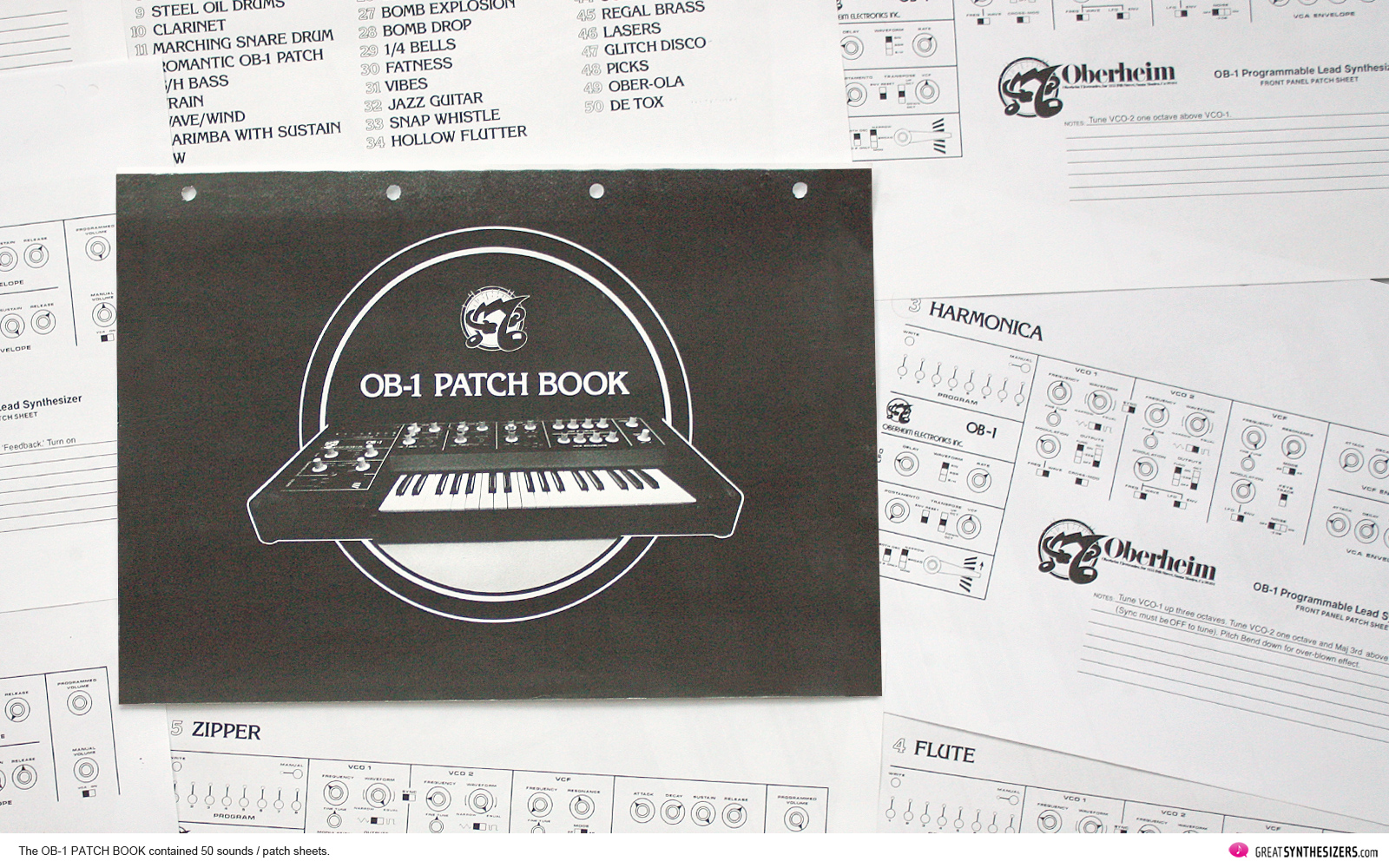
Ah … yes, not to forget the OB-1 Patch Book: a collection of 50 sound sheets for creating OB-1 sounds, from (1) Basic Tuning Patch to (18) R2-D2-OB to (50) De Tox… with a foreword by Russ Jones.
Structure of the OB-1
The one and only Oberheim mono synthesizer with keyboard features:
- 2 VCOs (sawtooth, pulse – both modulatable)
- 2 sub-oscillators (!) and noise
- Osc sync, cross modulation
- 2-pole/4-pole VCF with ADSR
- VCF keyboard tracking
- VCA with ADSR

- LFO (sine, pulse, S/H) with delay
- Portamento, ENV reset, octave +/-
- Combined pitch bender (narrow/wide) and …
- Modulation bender (vibrato or noise modulation)
- Audio Out High/Low, Audio In, CV/Gate In, CV/Gate Out
- VCF CV IN, Loudness CV IN (OB-1) or Modulation CV IN (OB-1A)

… and, of course, the aforementioned 8 memory locations. These memories already indicate that the OB-1 is confronting you with the “rasterization” issue: halftones in the VCO tuning, gradations in the filter frequency, etc. All controls with black knob caps are storable, which affects the entire sound generation with the exception of FINE TUNE. The non-storable elements, including the LFO settings on the left, have white knob caps.

This color logic applies to the later OB-1A. On the earlier black OB-1, the color scheme is exactly the opposite: white top = storable, black top = not storable. In 1977, storability was a sensation, but it obviously had some downsides. First, once sounds were stored, they could no longer be changed (as is also the case with the Roland Promars / Jupiter-4, RSF Kobol or Yamaha CS-40M / CS-20M), and second, the built-in battery posed a long-term hazard to the instrument.

In this context, allow me to jump forward to the present. In the mid-2010s, Bob Grieb / Tauntek created a new programmer board for the OB-1. Not only is it significantly smaller than the original, it also offers 64 memory locations and does not require a battery… very nice. But the best part is that once sounds are stored, they can be changed immediately: the OB-1 equipped with the Tauntek board is always in EDIT mode. This greatly enhances the OB-1…

OB-1 sound
Experts will already have discovered a few sound-related compromises on the OB-1: VCOs, sub-oscillators, and noise can only be mixed at two volume levels, keytracking is only ON or OFF, and the filter can only be modulated by either LFO or ENV. But these are all minor issues. And insignificant ones at that, because as soon as the OB-1 raises its voice, all criticism stops immediately, giving way to reverent silence and respectful listening.

Let’s start with the OB-1 lead sounds, which are out of this world. The VCOs can be fine-tuned exceptionally precise, leading to harmonic cancellations and new, unique overtone structures. Thus, the OB-1 can “sing” like no other synthesizer (… some people call this sonic quality “creamy,” which is an apt description). Its sync sounds are fantastic, and its bass sounds benefit from the 2 VCOs plus 2 sub-oscillators … it doesn’t get much more powerful than this! In many cases, the lower frequency power is even a little “too much”… but with nuanced filter control, you can easily tame the instrument.

Next: The effect sounds. They can be top notch without too much effort. Not quite in the same league as an ARP Odyssey or Sequential Pro-One, but pretty close. Osc-sync, cross-modulation, noise-modulation (via mod-bender), ultra-powerful filter self-resonance, enormously snappy envelopes, CV-controllable waveforms, external connections for filter CV and LOUDNESS (OB-1) or MODULATION (OB-1A) … the range of creative possibilities is remarkable and not immediately apparent at first glance (given the OB-1’s seemingly modest surface).

Ultimately, however, it’s clear that oscillators of this quality, a filter of this quality, and envelopes of this quality guarantee that the OB-1 must be counted among the top 10 mono synthesizers in music history. The enormously colorful filter resonance alone speaks for itself and allows for a multitude of musical sound variations that many other instruments can only dream of (except for the unique OSCar synthesizer, of course). Last but not least: The extremely fast envelopes (CEM3310 chips) transform the OB-1 into an almost perfect pattern-based sequencer-line synthesizer.

Hardware and Service
The OB-1 is basically superbly crafted (by American standards), with some pros and cons. Pros: The chassis is extremely sturdy and the surface area is very generous. Plenty of space between the elements guarantees relaxed working, and the OB-1 allows for precise work thanks to the pleasantly masculine (slightly stiff) potentiometers … Keyword: Osc FINE TUNE. The black switches and the keyboard, on the other hand, are not so wonderful. The switches are somewhat sticky and the keyboard is somewhat clunky.

As with most Oberheim synthesizers, the OB-1 needs a little maintenance from time to time. To eliminate a potential hazard, it is advisable to install the Tauntek Programmer-Board in order to remove the original Programmer-Board plus the old battery. Do that.
Second-hand prices
Unlike the SEM or the Two-Voice, the OB-1 has not yet achieved the Oberheim cult status it deserves given its sound potential. The generally subdued interest in this instrument is therefore also reflected in its price on the second-hand market: At the end of 2025, the value of an OB-1 tanges between 3,000 and 4,000 Euros / USD, which seems surprisingly low to us compared to other vintage mono-synth classics.

After all, the OB-1 is priced at about the same level as a vintage ARP Odyssey MKI (or MKII). If you compare the hardware quality of both instruments, it’s clear which one is preferable … (it’s certainly not the ARP synthesizer).

Anyway, the relatively low price of an Oberheim OB-1 should definitely be good news for those who recognize the creative potential of the excellent instrument and therefore don’t have to budget a fortune to purchase this classic monophonic synth …

GForce OB-1 Software
Nowadays, the OB-1 is also available in digital form, specifically in the OB-1 software from GForce. Its very existence is proof that the monophonic Oberheim synthesizer is considered a “classic” and therefore worthy of digital emulation. Here it comes with expanded modulation options, effects, and much more. The digital OB-sound is not identical to the vintage OB-1, of course, but that’s in the nature of software instruments. A little PR …
The GForce Oberheim OB-1 delivers a sound as full and robust as the legendary Minimoog® yet as aggressive and snarling as the MS-20®. It strikes the perfect balance between these two icons, making it an incredibly versatile tool in any producer’s arsenal.
Whether you’re conjuring deep bass lines or soaring leads or looking for something a little extra special, the Oberheim OB-1 is your ultimate ally in the studio.

All in all
When Tom Oberheim was asked a few years ago about his favorite (own) synthesizer, he reportedly chose the Two-Voice. Two SEMs in one package, plus a sequencer – a good and absolutely understandable choice. Nevertheless, regardless of the elegance of a Two-Voice, we might have opted for the OB-1. After all, the SEM – the bedrock of the legendary Oberheim sound – is available as a single module (you can have the sound of the multimode filter without the Two-Voice) or coupled multiple times as a Four-Voice or (rather unlikely) Eight-Voice.

Looking at the features in detail, the OB-1 seems to us to be the truly “unique” early Oberheim synthesizer with keyboard in the portfolio. It offers extra performance and sound design tools (bender, LFO with delay, full-fledged envelopes), an extremely versatile sound (2 VCOs + 2 sub-oscillators, waveform-modulation, noise, osc-sync, cross-modulation, noise-modulation, sample & hold), and 8 memory slots, which can now be expanded to 64 memories plus instant editing with a Tauntek upgrade. The OB-1’s hardware is high quality, although the somewhat clunky and hard-to-play Pratt & Read keyboard must be accepted as an (annoying?) vintage feature … as is the case with the ARP Odyssey, the Sequential Pro-One and others.
x

If you can live with that, then you will find the Oberheim OB-1 to be one of the best monophonic synthesizers ever built. Its sound – superior to all others – speaks for itself.
x
Over 40 minutes of audio files are attached. The OB-1 can be heard in 90% of the tracks. In addition, the Polymoog, the Technosaurus Selector modular system (Mix 1), and Minimoog / PPG 1002 (Mix 2) were used. Finally, a GRP R24 sequencer and an RS modular system from Analogue Systems served for external CV control (as in the two “Cosmic” demos).
Oberheim OB-1 / OB-1A
1977 – 1981
Monophonic Lead-Synthesizer
with Memories
Download / Open:
Oberheim OB-1 photo (4000x2500px)
Links:
Tauntek Oberheim OB-1 page (new programmer)
History of the Oberheim OB Series (Perfect Circuit)
GForce Software / Oberheim OB-1 plugin
Vintagesynth
Youtube:
The 1978 Oberheim OB-1 – An Underrated Enigma
by GForce Software
The Sublime Oberheim OB-1
by Alex Ball