
Syrinx: Anyone who assumes, based on Greek mythology, that this instrument’s strengths lie in flute-like sounds is mistaken: This mono synthesizer, which originated in the Netherlands in 1982, is one of the wildest and most unrestrained of its kind. This is largely due to both the touchpad and a chip known as the CEM 3350.

Syrinx and Pan — A Look into Mythology
The story has potential: In ancient mythology, the nymph Syrinx flees from the importunate shepherd god Pan. To escape his pursuit, she transforms herself into a reed. The aggressive breath of the approaching god of shepherds sweeps through the reeds, producing wondrous sounds. Captivated by them, Pan crafts a flute from the reeds. Voilà: the Syrinx (pan flute) was born.
Another story suggests that the sound of the Syrinx flute probably wasn’t all that incredible after all. Pan challenges Apollo to a musical duel, which – not surprisingly- the god of light clearly wins on his Kithara. Subtext 1: Flutes aren’t cool. Subtext 2: Even in ancient times, musicians were confronted with the ubiquitous dominance of plucked string instruments.
x

There is a certain irony in the fact that the name of the Synton Syrinx — which sounds so wild and unrestrained — is derived from a gentle spirit or, more specifically, from the pan flute that originated from it. Nevertheless, the events surrounding the nymph now seem to be repeating themselves: Hardly any other vintage monosynth is as coveted as the Syrinx; musicians around the globe are on the hunt for this instrument.
Syrinx, Spirit and OSCar — A Look Back at the ’80s
In addition to this foray into mythology, it’s also worth taking a brief look at the synthesizer universe of the 1980s. Three instruments saw the light of day: Synton Syrinx (1982), Crumar Spirit (1983) and OSC OSCar (1983). These late “Made in Europe” mono synthesizers have quite a bit in common: they were produced in limited quantities, have mediocre hardware, and yet feature a fabulous filter design — which, as said before, makes them rare collector’s items.
x

AES Convention in Montreux — The Birth of the Syrinx
First, it is worth noting the interesting fact that a Synton Syrinx already existed in 1973 (source: dutchsynth.eu), a 4-octave synthesizer in the style of the Steiner-Parker Synthacon. However, it was the instrument developed in the early 1980s that eventually went into production. The prototype of the Synton Syrinx was unveiled in May 1982 at the AES Convention in Montreux, Switzerland.
In the 1980s and 1990s, these Audio Engineering Society (AES) conventions were among the most important platforms for innovative studio technologies — alongside the Musikmesse in Frankfurt and Midem in Cannes. The Fiato Fair in Amsterdam is cited as another venue where the Syrinx was presented. The Mono-Synth was distributed by Synton itself, as well as by PPG (Germany), Rod Argent’s Keyboards (UK), and Big Briar (USA).

The Syrinx, developed by Felix Visser, Marc Paping, and Bert Vermeulen, remained in production until late 1984 / early 1985. Its retail price was 1,500 DM, making it slightly more expensive than a Korg MS-20 (1,200 DM). Given today’s collector prices, it was still a bargain, though. In addition to the classic black color, the Syrinx was available in blue, red, titanium (silver-white), white, purple and orange (assuming the information in synth-literature on this subject is correct), and possibly in other colors as well.
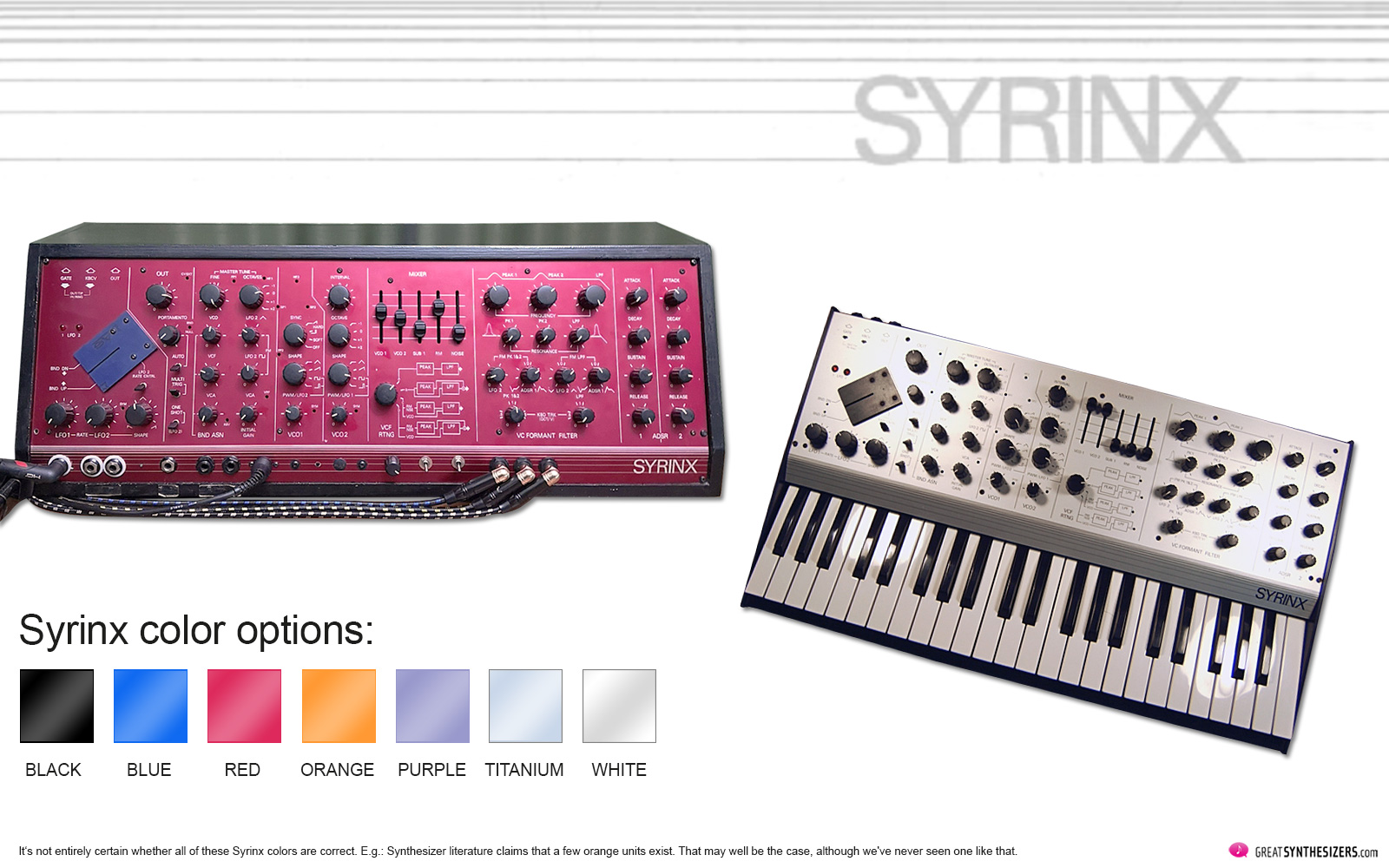
After several hundred Syrinx units had been manufactured and production stopped end of 1984 or early 1985, a final series of six “Last-Syrinx” units was released in 1995. These models — all in red — were made from leftover inventory and were offered exclusively as tabletop synthesizers with DIN/MIDI connector due to the lack of available keyboards (see the images from a Reverb auction further below). And with these six “Special & Last Edition” units, the Syrinx chapter came to a definitive end.
So much for a brief look at the history. Synton — founded as early as 1973 and led by Felix Visser — produced not only the mono-synth Syrinx, but also modular systems (e.g. 3000 Series), various vocoders (Syntovox), and other studio equipment (e.g. VC Phaser). Starting in the late 1990s — by which time Synton had already ceased to exist — the Fénix modular system was finally released.
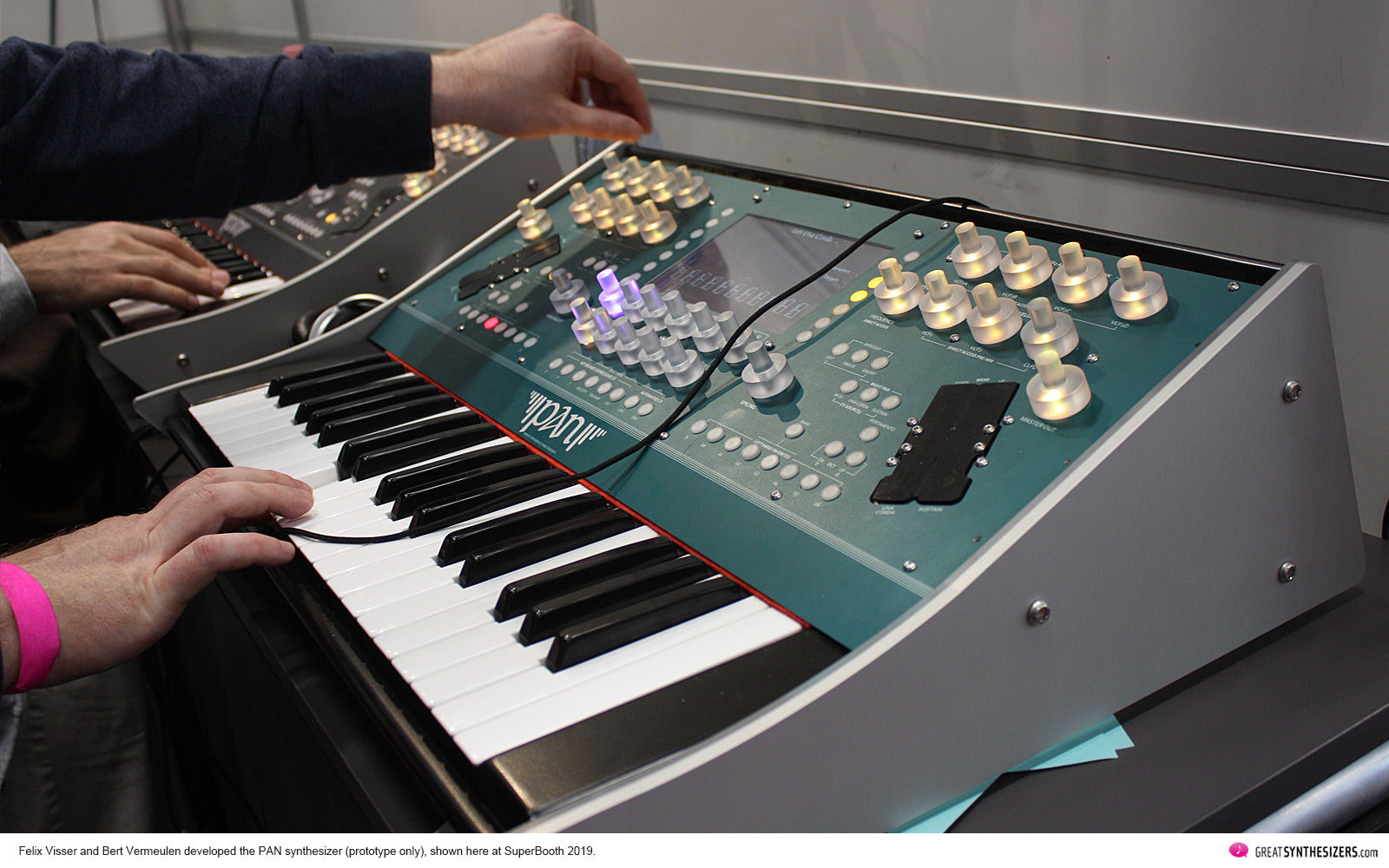
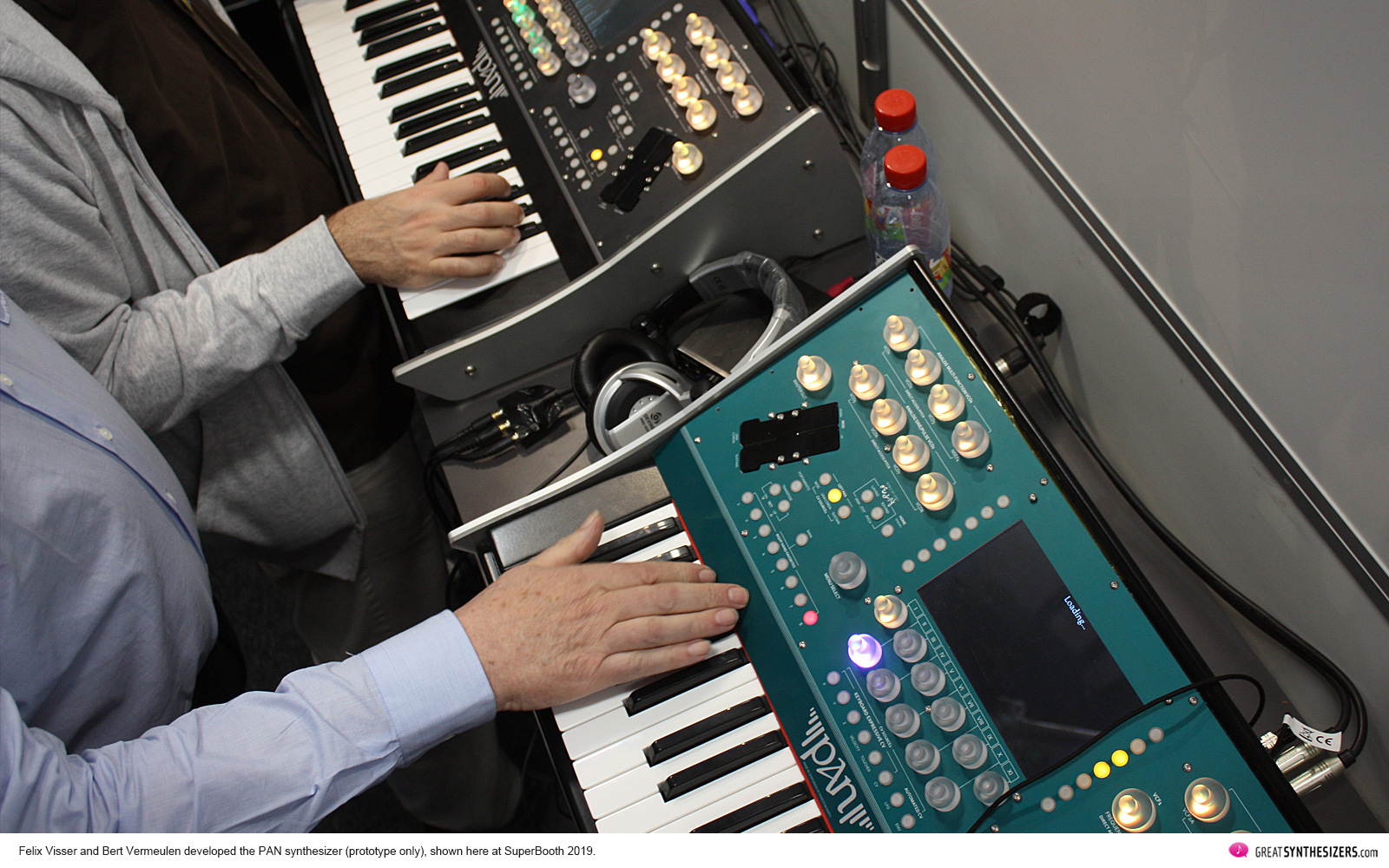
Around 2020 there were also new developments in a modern Syrinx known as the Syntonovo PAN. The instrument, which was showcased at SuperBooth in 2017, 2018, and 2019, caused quite a stir with its XYZ Expression keyboard and its various prototypes, but — as far as we know — never made it into mass production. Sadly, co-developer Felix Visser passed away in late 2025.

Structure of the Syrinx
The monophonic Syrinx features:
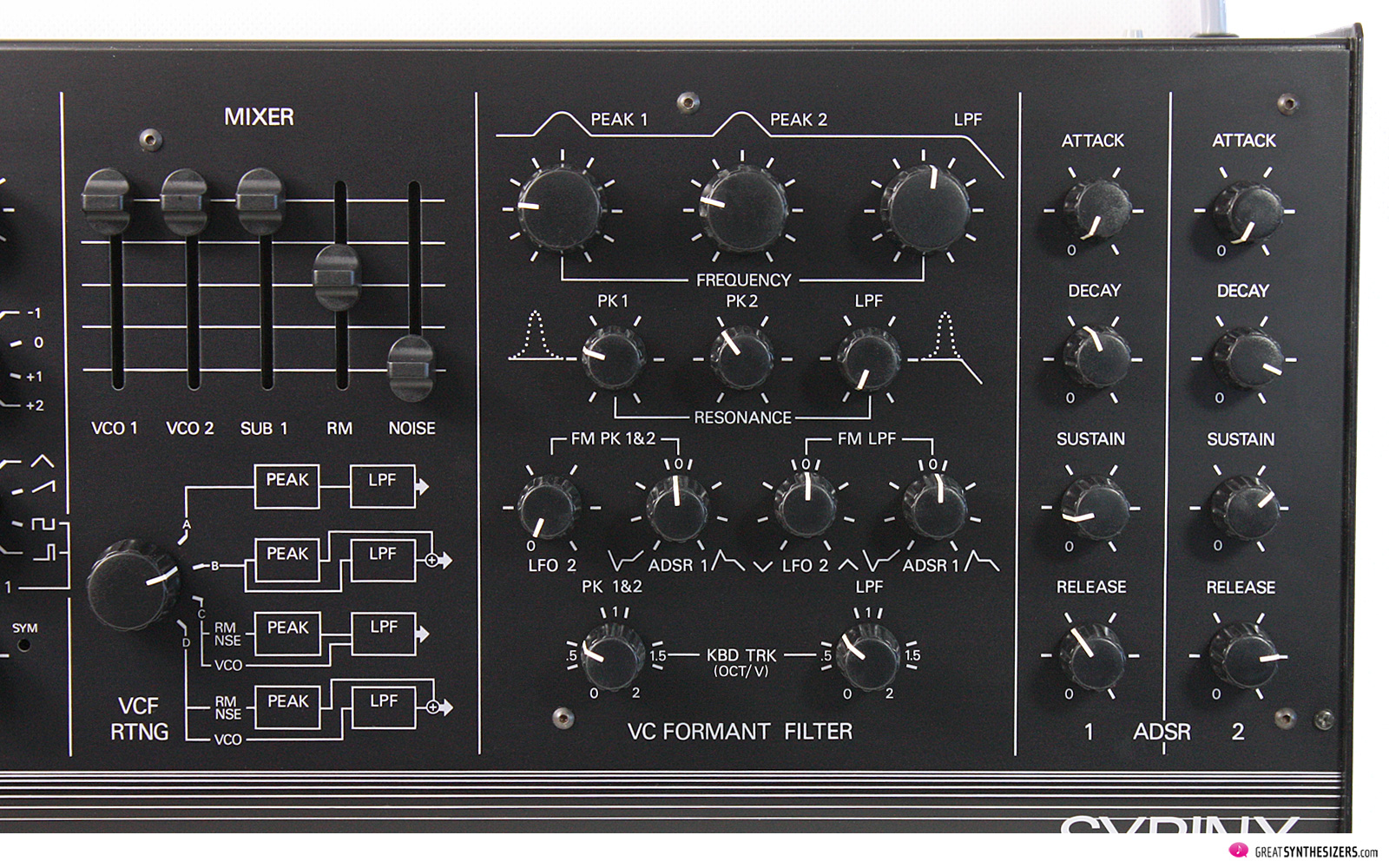
- 2 VCOs with PWM and Osc-Sync (2x CEM 3340)
- Mixer section with extra sub-osc, ring modulator, and noise
- 3 VCFs — 2x BandPass PEAK, 1x LowPass LPF (2x CEM 3350)
- 4 routing options for sound sources to PEAK and LPF
(parallel and serial connection of PEAK and LPF) - 2 LFOs; LFO 2 speed modulation (touch pad)
- One-shot function for LFO 2 (attack-decay)
- 2 ADSR envelopes (2x CEM 3310)
- 1 dual VCA (1x CEM 3360)
x

In addition, the Syrinx features:
- a hold function (Initial Gain)
- a 44-key keyboard (3.5 octaves)
- single / multi trigger, portamento with auto (legato) mode
- a touchpad for controlling VCO, VCF, VCA (and LFO 2 speed)
- AUDIO OUT (also suitable for headphones)
- CV/Gate inputs/outputs
Dimensions / weight:
- 62 x 36 x 12 cm
- 8 kg
Criticism of the Hardware
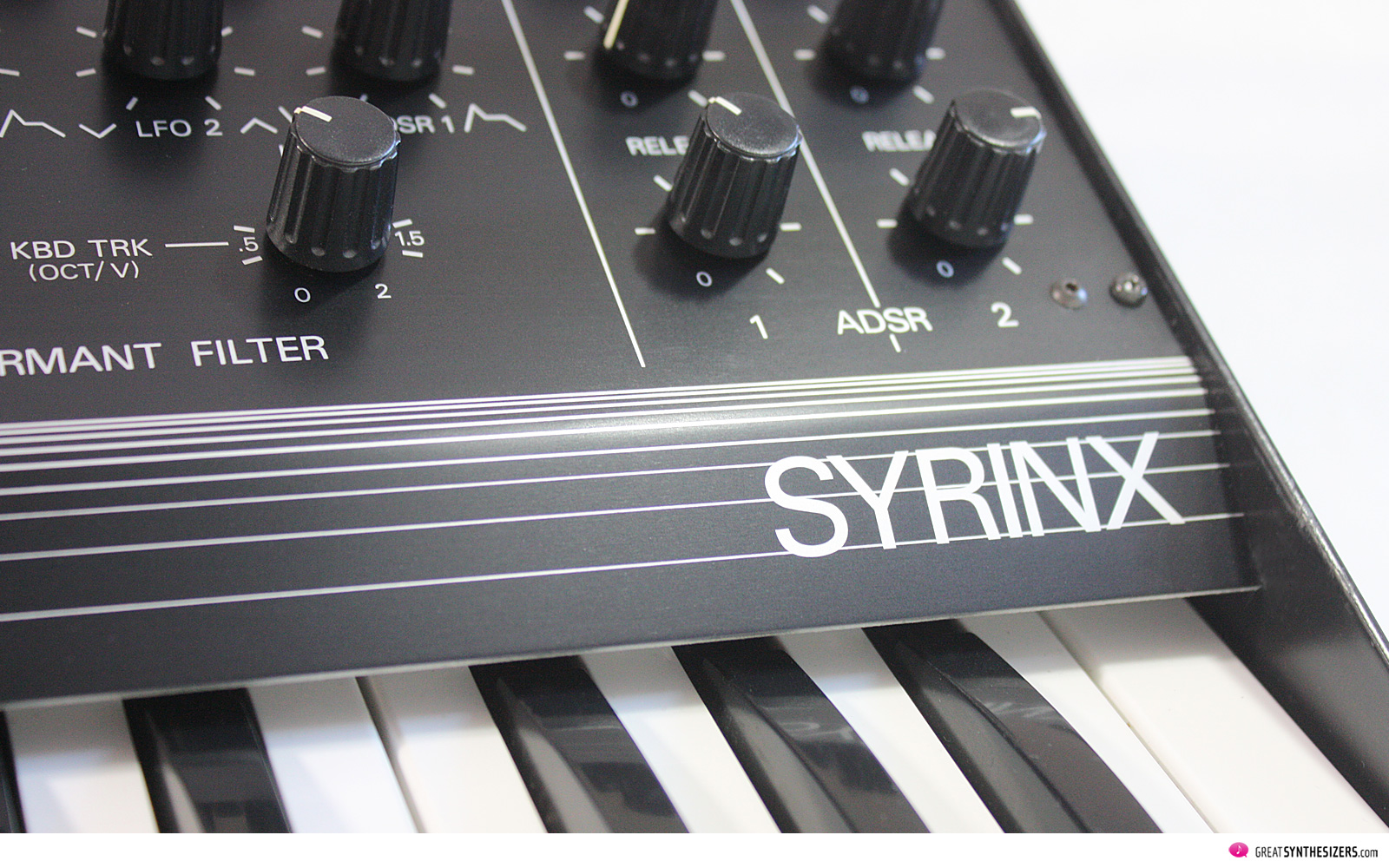
Before we get to the Syrinx’s unmistakable musical strengths, allow me to offer a bit of criticism regarding its hardware. The Syrinx is encased in an all-metal housing — as simple, functional, lightweight, and slim as it gets. The rotary knobs are all a bit wobbly and lack resistance, which does take some of the joy out of operating the Syrinx (here, the striking parallel to the Crumar Spirit is evident).
This lack of sturdy potentiometers could be remedied relatively easily by attaching extra washers to the Syrinx’ surface (see similar solutions on the Sequential Pro-One). In fact, we’ve already done this on a Syrinx (with good results), but with a synthesizer worth several thousand Euros, attaching washers with superglue is a decision that requires careful consideration. We wouldn’t do it that way anymore.
Praise for its sound potential
Explicitly praising the Syrinx’s potential may seem like stating the obvious. And yet it never ceases to amaze me what soundscapes the routing options and filters conjure up. And the mixing of sound sources. And the oscillator synchronization. And the ring modulator. And the LFOs. But it is only through the right kind of performance that all of this comes to life — namely, that performance via the touchpad.
This touchpad may feel unfamiliar at first to long-time Roland Bender (or Moog Wheel) users. Critics claim that the tool is “too” sensitive and often difficult to control. That may be true. But that is precisely what makes the Synton Syrinx so appealing: its wild, uncontrolled, and untamed timbres, its biting and at times malevolent dynamics. Its overdrive, its overtones…

That brings us to the key word: dynamics. What sets the Syrinx apart is its liveliness. Extremely quiet, extremely loud – changes in a fraction of a second. Extremely rough, extremely clean (the CEM oscillators can’t quite hide their origins), also in a fraction of a second. What tool could be used to achieve this? Bender? No! Wheel? No! Touchpad … Voilà.
The beauty of it (and I’m sure most fans of vintage synthesizers will nod in agreement here) is that the Syrinx requires LIVE performing. Vocal sounds created by tweaking Peak 1 / Peak 2 and applying VCF movements via touch pad … wonderful. No triggering via DAW, no external controller … nope — it’s up to the musician — touch the Syrinx and bring it to life!

The resulting sound can be heard in the attached 40+ minutes of audio material. Or at least part of it. In terms of sound, the Syrinx is certainly hard to categorize … there isn’t just “one” typical Syrinx sound! Some elements are reminiscent of the OSCar synthesizer, some of the Crumar Spirit, some of the Roland SH-5, others of the ARP 2600 or Sequential Pro-One, and some of a solo voice from the Yamaha CS-50/60/80.
In short, there’s no way to categorize it. While there’s the Moog Sound and the Roland SH Sound — each with its own nuances — there’s no such thing as a distinctive Synton Sound. And that’s excellent. It’s what makes the Syrinx the one-of-a-kind synthesizer that it is. A true replacement isn’t really in sight, although there have been attempts to create modern alternatives to the Syrinx in the 21st century – such as, for example …
x

SER-2020 and LARYNX from AnalogFX
The Belgian company AnalogFX has taken on the challenge. With the SER-2020, it offers a rack-mount replica of the Syrinx. SER-2020 features CV inputs and outputs as well as a touchpad (anything else would be surreal). MIDI and USB are a given. It also comes in a variety of colors. Quite appealing, thanks to its consistently solid design, Eurorack compatibility, and (now-updated) high-quality hardware. All of this for a tenth (or one-twentieth) of the vintage price. Thanks!
x

As a bonus, AnalogFX also offers the “King” of the series, the LARYNX. It comes with a keyboard and thus looks quite similar to the original Synton Syrinx. The crucial question, of course, is: How does the instrument sound? Judging by the demo videos, the sound quality is very good. Whether the sound has the vintage vibe people are looking for, we can’t tell. While the manufacturer attempts to stay true to the original using CEM3340-based VCOs and a triple CEM3350 filter architecture, it’s up to each listener’s own ears to decide whether it actually succeeds.
x

Secondhand prices
The rarity of the Syrinx stems primarily from the small number produced. In the early 1980s — a monophonic synthesizer overshadowed by emerging digital technology — only a few hundred Syrinx units were made, and that was it. Added to its rarity is its iconic sound — and so, since the 1990s, most Syrinx units have found a permanent home in studios around the world. This has led to some outlandish prices on today’s used market. 15k or more for a Syrinx? It’s not out of the question …


Be that as it may, we all know that such exorbitant asking prices and the prices actually paid are usually not the same. And since quite a few of the rare Syrinx auctions end with a successful bid, exact sale prices cannot be determined afterward. In any case, it is clear that the Syrinx commands high prices among collectors, whether it’s a model in black or in one of the (even more sought-after) color variations. And if you’re lucky, you find one of those units that features a comprehensive CV upgrade on the back (most likely implemented by Synton).


All in all
Way back in 1984, buying a handful of Syrinx models would have been a great investment. Preferably Syrinxes in several colors … blue, red, titanium … if you’d already been around (I was) and if you’d had some savings set aside (I didn’t). Originally available at a bargain price of 1,500 DM, the instrument is worth many times as much now. But what’s the point: “If only … would have, could have, should have”… hindsight is always 20/20. In 1984, the eventual success of this Dutch mono-synth was certainly not foreseeable at all.

Today’s perspective: the Syrinx is exactly what it is … unique! It delivers pure dynamism that comes to life in real time through the touchpad and human interaction. Vocal sounds and filter drones at their finest. Sequencing performances in every shade imaginable (we recommend listening to the sample “No Mercy 1“), ranging from barely perceptible to frighteningly aggressive (you can almost feel the breath of Pan, the god of shepherds). Lead and bass sounds with subtle nuances and powerful drama, shifting in a matter of seconds. No other instrument can do this.
But of course, not everything is perfect with the Syrinx. Longer envelope times, more modulation destinations for LFO 1, additional CV jacks, knobs that don’t wobble as much, and a slightly more refined chassis would have been a nice touch for the instrument. There are also questions about service availability today (the all-important CEM 3350 VCF chips are almost impossible to find). In light of these considerations — and given the high prices on the used market — a reissue of the Syrinx would therefore be highly desirable.

However, such a reissue would then have to deliver the exact same lively Syrinx sound. That’s a lot to ask, but it’s not so much an option as it is an obligation. In fact, despite their respectable, very powerful basic tone (which, in our opinion, is a bit too clean and modern), current Syrinx clones and replicas do not yet seem to quite capture that lively Syrinx sound. So for now, we are left with a well-known concluding observation. One that has already been made regarding other instruments: “Only the original is the original.”
Addendum: ADSR / LFO Triggering
A quick note on external triggering and, specifically, the Syrinx’s LFO behavior. Both LFOs are key-triggered, meaning they restart their cycle with every key press. This makes perfect musical sense, as it allows you to simulate a kind of synchronization between melody and modulation—even if it isn’t true LFO synchronization. However, you often want freely running LFOs, for example, to refine a running sequence (or a spontaneous solo) with slow filter sweeps. To do this with the Syrinx, you need a little trick …

If the attached GATE-IN signal measures 10V or more, the external trigger affects both envelopes and LFOs (sequence and modulations are synchronized). If, on the other hand, it measures only 5V, only the envelopes are triggered, while the LFOs run freely. If you want this behavior during normal play on the Syrinx (without external control), simply simulate a weak external trigger signal by plugging an empty jack into the GATE-IN jack (ring position!). The keyboard will trigger normally based on your playing, and the LFOs will still run freely.
x
And now, on to the music. The attached sound files feature almost exclusively the Synton Syrinx. Exceptions: “Short Solo 2” — the Syrinx flute sound (so there it is!) with a simple COTK Model 55 sequence — as well as occasional beats from the Roland TR-606 Drumatix. Everything else is pure Syrinx. Recording: Freeware Audacity.
Synton Syrinx
1982 – approx. 1985
Monophonic analog synthesizer
with triple filter and touchpad
Dimensions: 62 x 36 x 12 cm
Weight: 8 kg
Download / open:
Synton Syrinx photo 1 (4200x2800px)
Synton Syrinx photo 2 (4200x2800px)
Links:
Synton Syrinx (Vintagesynth.com)
SER-2020 and LARYNX (AnalogFX)
Dutch Synthesizers (Dutchsynth.eu)
Fénix Modular Synthesizer (Wikipedia.org)
Youtube:
Synton Syrinx Demo
by Perfect Circuit
AnalogFX SER-2020
by loopop