


We guarantee that you’re in for some surprises with the Novation Bass Station II (aka Bass Station 2). Not that we’re trying to play down its already superb reputation as a tried-and-true TECHNO synthesizer. But its vast sound potential “above and beyond” caught even us by surprise.
Existing biases against small instruments (table toys) – I’m talking from experience – may begin with their names. In our case, we’re talking about a BASS station! Now, we all know about those … Roland TB-303 Bassline … Deep Bass Nine … TB3 … Propellerhead ReBirth 338 (ok, ok, software) … Acidlab Bassline … and and and. Bass here, bass there. For decades, the hype of the deepest sounds has been ringing in our ears.
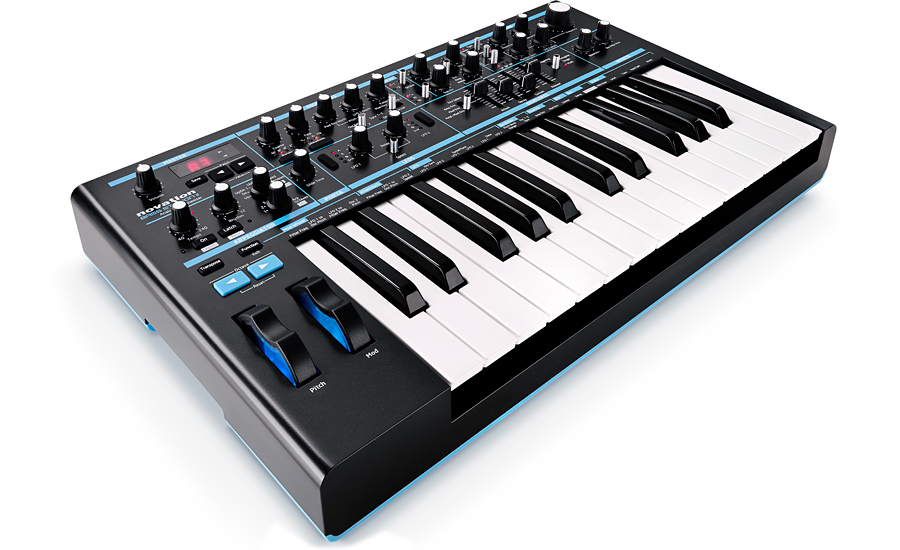
But the Bass Station II is not just a simple bass- and groove-box. Not any longer, in any case. The first Novation Bass Station anno 1993 was admittedly a classic (indeed first-class) bassline clone, but its successor has mutated into a full-blown analog synthesizer. Yes, yes, yes, you still have got those wonderful bass-sounds at your fingertips, but there’s all that additional sound repertoire waiting to be sounded out (our pun).
Taken from this point of view, the name “Bass Station II” doesn’t quite do the ticket. That’d be pushing the instrument into a corner when it belongs in the middle of the room!
2 oscillators, sub-oscillator, ring-modulator and noise
This synthesizer has analog oscillators, but DCOs and not VCOs. Since there’s no clear info on the oscillators (neither in the user’s manual nor on the manufacturer’s website), we have the information directly from Novation. By the way – their customer service is friendly, fast and professional.
But to the point in question – DCOs versus VCOs, which are better? They’re all analog oscillators! Your choice will be a matter of taste. Do you prefer the drifting and liveliness of the VCOs? Or do you rather appreciate the stable tuning of the DCOs? The point is, this instrument uses ANALOG oscillators. And that’s clearly audible! Listen to the soundfiles “Stereo bass 1” and “Ring Mod 2” – pure analog elegance!
The Bass Station II’s oscillators do have the power you need. The instrument’s basic sound is convincing and versatile: soft, aggressive, subtle, a little weird … Heaps of interesting sounds and/or effects can be created simply by tuning and de-tuning the oscillators. And all those tonal subtleties are possible thanks to their inherent analog character!
PWM is at your disposal, of course. PWM parameter range is 5 to 95, where 50 corresponds to a square wave. Extreme clockwise and anti-clockwise settings produce very narrow positive or negative pulses, with the sound becoming thinner and more “reedy” as control is advanced. It would have been great, hoewever, to be able to make the pulse sound completely disappear (parameter range 0 to 100 > possible with very few analog synthesizers). And, well … Osc-Sync is there, too.
At this point it would be logical to continue explaining the instrument’s further signal path … filter, amplifier, etc. But we would like to take a closer look at the oscillator section. The TWO DCOs (with all their creative possibilities) set the Bass Station II apart from other analog synthesizers in the low-end price segment (at ~ 500 Euros / USD). They open up musical realms not available in other synths in this price range. These two oscillators are one of those Bass Station II’s qualities that make a difference!
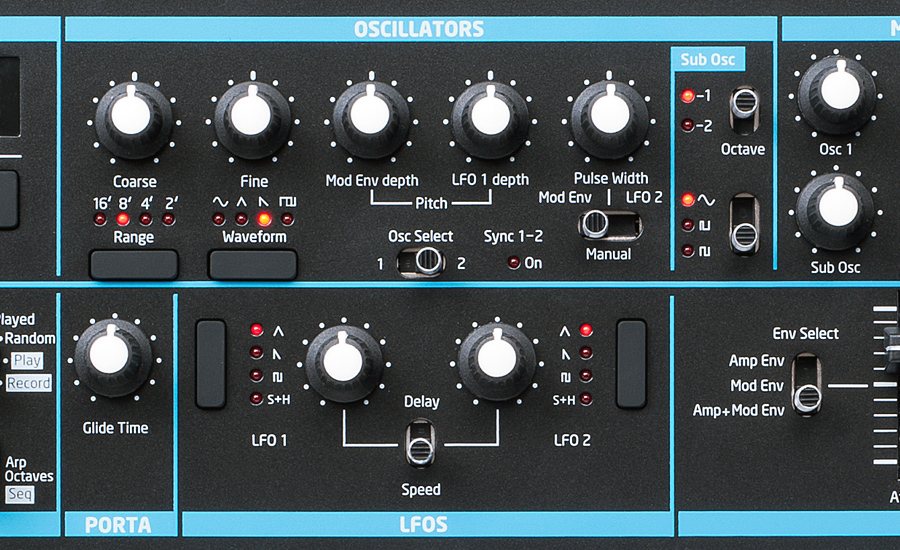
Each oscillators has …
… 4 waveforms:
- sine – triangle – sawtooth – pulse. PW can be varied manually or automatically (via Modulation Envelope or LFO 2)
… a vast tonal range:
- 4 octaves (16′ – 8′ – 4′ – 2′) via the classic RANGE switch
- +/- 1 further octave via the COARSE rotary control (for setting intervals, etc.)
- the FINE tuning knob adjusts the oscillator’s pitch over a range of +/- 1 semitone (this is for creating those wonderful analog beatings between the two oscillators)
- 9 additional octaves via the OCTAVE SHIFT KEYS right next to the keyboard (-4 to +5). This changes the pitch of both oscillators, of course. In the lower “octave shift” area, the DCOs act as Low Frequency Oscillators, whereas in the highest area they disappear beyond the human audible frequency range! This enormous tonal range is one of the main reasons for the instrument’s versatility, and hence one of the big advantages of the Bass Station II
- Last, but not least, there’s TRANSPOSE, which lets you transpose the keyboard in semitones, up to a maximum of +/- 1 octave
Considering the whole of the oscillator’s frequency range, we have lost perspective! Is it 14 octaves, 15 octaves … ? In any case, more than enough …
… heaps of modulation possibilities:
- the frequency of either oscillator may be varied by the modulation envelope (ADSR) and by LFO 1, modulation settings can be positive or negative …
- both oscillators can be modulated by LFO 1 via aftertouch and modulation wheel
- oscillator 2 can be varied directly by the modulation wheel. This can be set by one of those brilliant On-Key Functions (Mod Wh: Osc 2 Pitch). The Osc 2 Pitch parameter controls the degree to which the pitch of Osc 2 is modified when using the Mod wheel. This is useful for sweeping Osc 2 by a greater amount than is possible using the Pitch wheel. Positive values increase the modulation, resulting in a maximum pitch change of 96 (!) semitones, or 8 octaves. Negative values reduce the oscillator pitch modulation by a similar maximum amount. Great stuff for those screaming sync sounds and spacy effects!
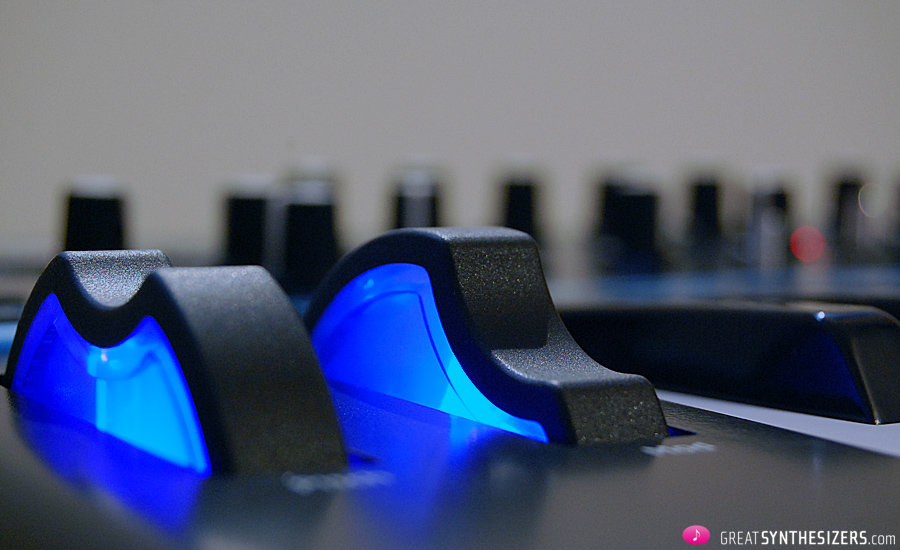
- both oscillators can be bent by the pitch bender: a maximum of two octaves can
be selected (+/- 24 semitones)
As you can see, the Bass Station II’s oscillator section turns this tiny (if not to say inconspicuous) synthesizer into a sound colossus! But: we all know, the most impressive list of audible features does not say anything about the sound itself. This is why we have added 40 (well, to tell the truth, it’s 50) minutes of Novation Bass Station II soundfiles. It’s all PURE Bass Station II, no additional instruments were used for the recordings. This analog goodie not only offers tons of features, but SOUNDS beautiful, too.
So … two oscillators in this tiny instrument. How does that work? Novationb has found a clever solution on how to offer direct access to both oscillators, without having to increase the instrument’s size. A little silver switch does the job. Start with one oscillator, do all your settings and adjustments, then switch to the other DCO. It’s as clever as simple!
Further sound sources
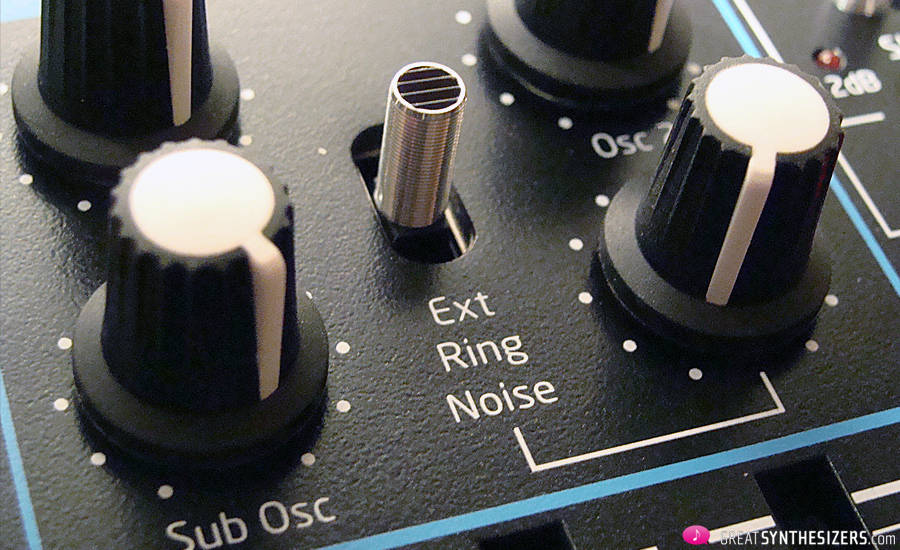
In addition to the two main oscillators, Bass Station II has a “sub-octave” oscillator, thats output can be added to those of Osc 1 and Osc 2 to create astouning bass sounds. The sub oscillator’s frequency is always locked to that of Osc 1, meaning that the pitch is either exactly one or two octaves below it. You can select between 3 sub-osc waveforms: sine, narrow pulse and square wave.
Then there’s a ring-modulator, noise and an external (audio) signal control. These three sources “share” a single level control, though any mix of the three may be used. The Ext / Ring / Noise switch assigns the level control (rotary knob) to one of these three sources at a time; having set the level in the mix for one of them, you can move on and add another source to the mix without altering the level of the first.
All in all, the following 6 sound sources exist side by side in the little Bass Station II mixer:
- DCO1
- DCO2
- Sub-Oscillator
- Ext Signal In
- Ring Modulator
- Noise
Let’s filter the sound …
Well, after this opulent oscillator / audio section we do not expect an ordinary filter, but rather something very extravagant …

A multi-mode VCF with two basic filter styles …
- Acid (fixed-slope, 4-pole 24 dB)
- low pass
- Classic (variable slope, 12dB / 24dB)
- low pass
- band pass
- high pass
… with lots of modulation routings:
- modulation envelope (+/-)
- LFO 1 (+/-)
- DCO 2 (!) – for weird filter-FM noises and sound effects
- direct filter frequency control via the modulation wheel (simple, but very effective)
- LFO2 modulation via the modulation wheel (wah wah effect)
- control of the modulation (filter) envelope via velocity
- control of the filter frequency via aftertouch
The huge filter FREQUENCY knob is worthy of note. It’s the “ultimative” performance tool, in our opinion. First, it serves for filter frequency adjustments (this was clear, of course).
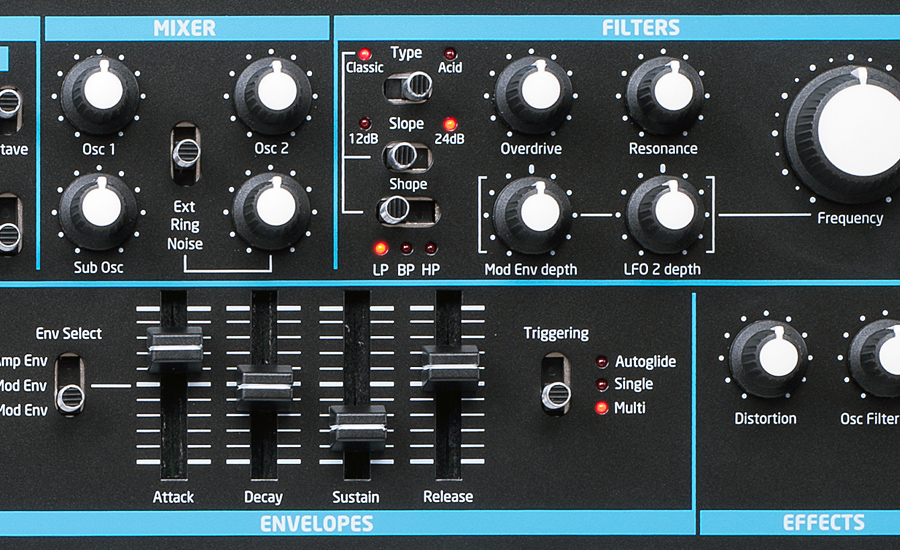
Second, at high resonance settings, it helps you to surf bit by bit through the beautiful overtones. The sound changes with every millimetre you turn the frequency knob … so, the bigger the knob, the better sound-control and -performance.
We have already mentioned filter-FM by DCO 2. Then there’s OVERDRIVE (distortion signal is added before the VCF) and a separate DISTORTION effect (distortion signal is added before the VCA). Important effects for creating typical 303-bassline sounds!
ADSR … and … ADSR
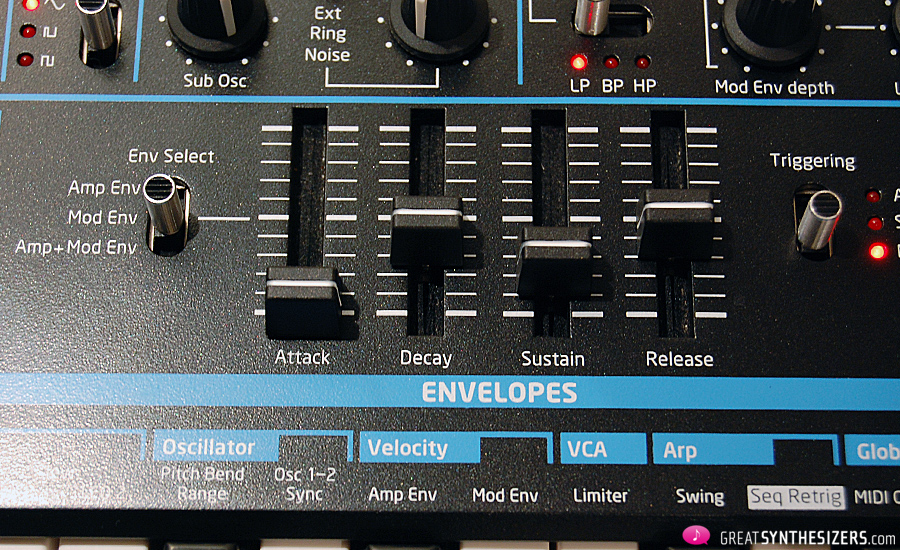
The Bass Station II has two envelopes. One for the VCA and a general MOD envelope (for the VCF, but also for other parts of the signal path). The envelopes can be programmed independently, or together. There is a silver switch here, too, for envelope selection, as in the DCO section (switching between the oscillators) and the LFO section (switching between LFO1 and 2).
Envelope triggerung can be SINGLE, MULTI or in AUTOGLIDE mode.
- Single – the selected envelope(s) is triggered for every note that is played on
its own. However, if playing in a legato style then the envelope(s) will not trigger - Multi – the selected envelope(s) is always triggered for every note played,
regardless of playing style - Autoglide – this mode works in the same way as Single, but portamento is applied only to those notes played in a legato style
Low Frequency Oscillators …
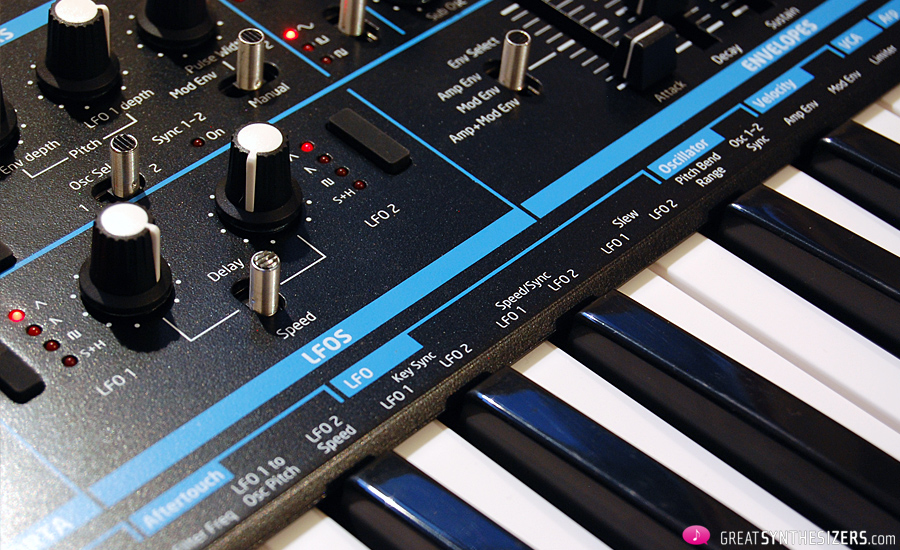
Bass Station II has two separate Low Frequency Oscillators (LFOs), designated LFO 1, and LFO 2. They are identical in terms of features, but their outputs are routed to different parts of the synth and are thus used differently …
LFO 1
- can modulate the pitch of Osc 1 and/or Osc 2; the amount of modulation is adjusted in the oscillator section with the LFO 1 depth control
- can modulate the pitch of both Osc 1 and Osc 2 via the Mod wheel, if enabled by the On-Key function Mod Wh: LFO 1 to Osc Pitch (lower C#)
- can modulate the pitch of both Osc 1 and Osc 2 via keyboard aftertouch, if enabledby the On-Key function aftertouch: LFO 1 to Osc Pitch (lower F)
LFO 2
- can modulate the pulse width of Osc 1 and/or Osc 2 when the waveform is set to square/pulse, and the pulse width modulation source switch is set to LFO 2
- can modulate the filter frequency; the amount of modulation is adjusted in the Filter Section with LFO 2 depth control
- can modulate the filter frequency via the Mod wheel, if enabled by the On-Key function Mod Wh: LFO 2 to Filter Freq (lower D)
Speed and delay can be set independently for each LFO (there it is again, the fabulous silver switch)! The frequency range of the LFOs is imposing, by the way … “from zero to about 190 Hz” (source: Bass Station II manual, page 16).
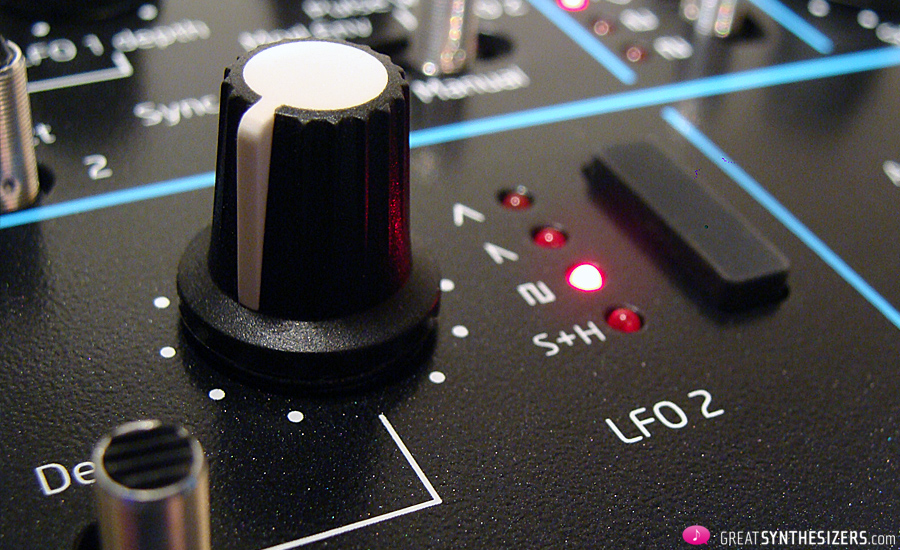
The higher settings are important for weird fx-sounds and other crazy modulation stuff. What we really love is the lower end of the LFO frequency. Ultra-long filter sweeps and ultra-subtle pulse-width modulation is possible, just to name two examples!
Then there’s KEY SYNC (the LFO’s cycle re-starts with each note) and SPEED / SYNC (allowing to synchronize the LFOs to an internal or external MIDI clock). Both are selected by the On-Key functions …
Sequencer and arpeggiator
These little tools are so important! Back in 1981, a Sequential Pro-One had such wonderful features (turning it into one of the most desirable analog mono-synths ever). Responsible for the instrument’s success was the simplicity of the tools. Same with the Bass Station II. Both sequencer and arpeggiator are easy-to-operate, ingenious performance components.
The arp pattern is selected by three controls:
- Rhythm – the arpeggiator comes with 32 pre-defined arp sequences; use the Rhythm control to select one. The sequences are numbered 1 to 32 – the sequences increase in rhythmic complexity as the numbers increase; Rhythm 1 is just a series of consecutive crotchets, and higher-numbered rhythms introduce more complex patterns and shorter duration notes (semiquavers)
- Arp Mode – the setting of this multi-position switch roughly determines the order in which the notes making up the sequence will be played:
- Up
- Down
- UpDown
- UpDown 2
- Played (key order)
- Random
- Arp Octaves – allows upper octaves to be added to the arp sequence
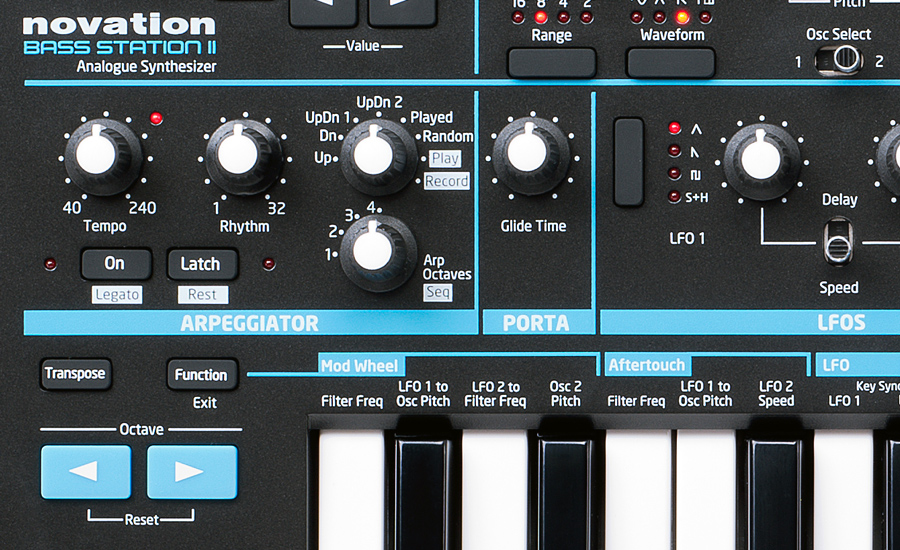
And … yesssss … there’s LATCH, too. A simple HOLD function, that works not only in ARP or SEQ mode, but also in regular playing mode. “Hold” is very important on any synth. It’s a great help in programming complex sounds (without having to hold the keys down).
Last, but not least, a SWING factor can be added via one of the On-Key functions.
The sequencer is as simple as the arpeggiator. It’s a cute 32-note step-sequencer with 4 memory locations. These sequences are stored in the Bass Station II and are retained when the synth is switched off. In addition, the currently selected sequence is stored as part of a patch.
Notes, rests and legato-playing can be recorded. Simply press RECORD, play some notes, press PLAY and that’s it! What a pity that the sequencer does not record the length of the notes. But, ok, we prefer this simple (and intuitive) Bass Station II sequencer to any complex, high-end step-sequencer that is the death of creativity.
Keep in mind: the less complicated the operation, the better the results :o) !!!
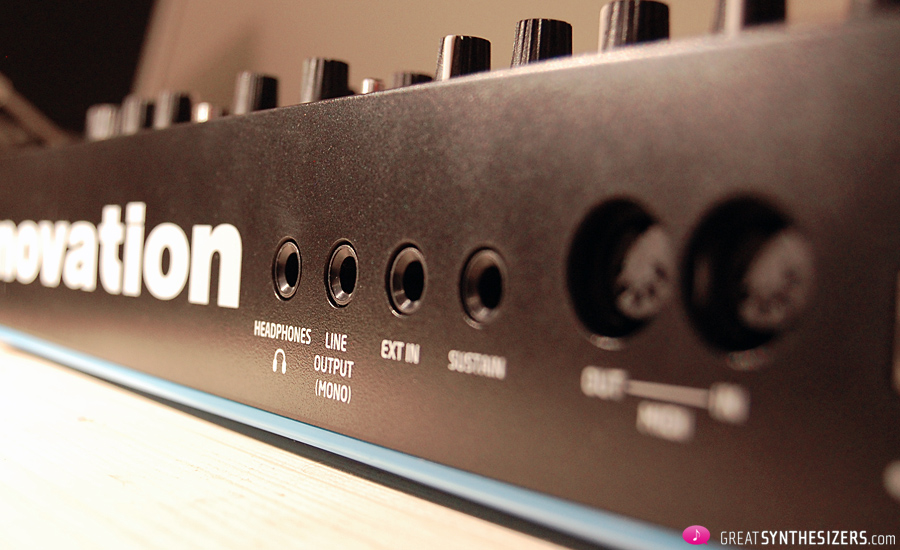
MIDI, USB, velocity, aftertouch and more …
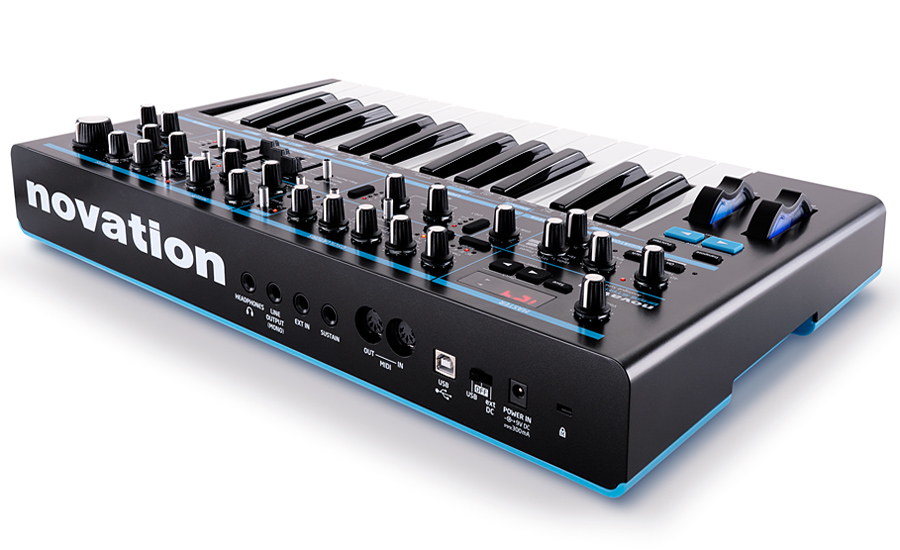
Comparing the Bass Station II with other synthesizers (Arturia MiniBrute, MicroBrute or the Moog Minitaur, for example), it has one big conceptional difference: the Novation synth has no CV/gate! We want to make this clear. Owners of Eurorack modular stuff who wanna interact with their new analog synthesizer are probably on the lookout for something else.
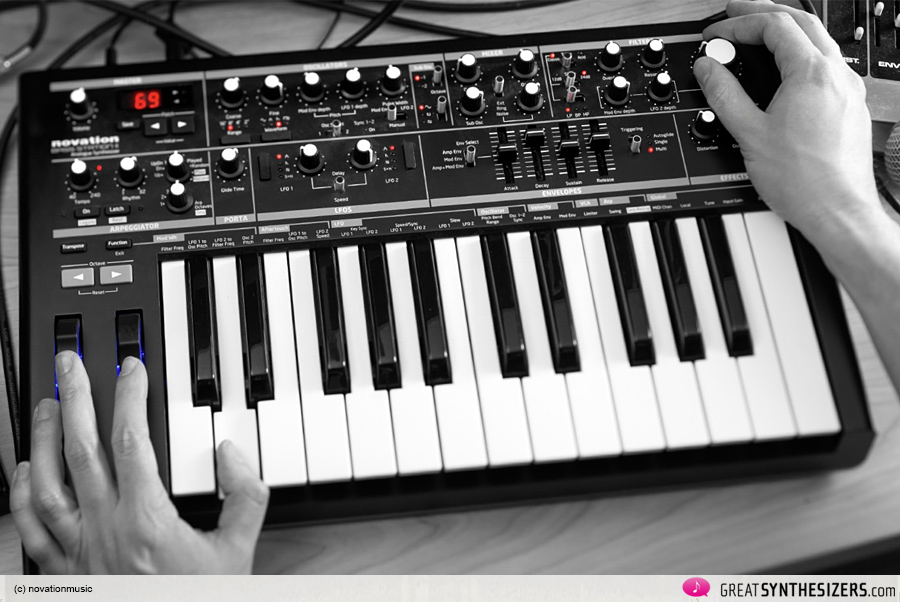
Despite this, the Bass Station II IS equipped with all the necessities of a modern studio instrument: MIDI and USB, as well as velocity and aftertouch. The 2-octave keyboard is a pleasure to play, by the way …
On-key Functions …
Bass Station II uses On-key functions to adjust nonperformance sound parameters and to minimise the number of controls. This reminds us of the OSCar synthesizer, which doesn’t come as a surprise, since OSCar-developer Chris Huggett is a member of the Novation team.
Each note on the keyboard has a specific On-key function, marked on the panel above each key.
- Mod Wh: Filter Freq (bottom C)
- Mod Wh: LFO 1 to OSC Pitch (lower C#)
- Mod Wh: LFO 2 to Filter Freq (lower D)
- Mod Wh: Osc 2 Pitch (lower D#)
- Aftertouch: Filter Freq (lower E)
- Aftertouch: LFO 1 to OSC Pitch (lower F)
- Aftertouch: LFO 2 Speed (lower F#)
- LFO: Keysync LFO 1 (lower G)
- LFO: Keysync LFO 2 (lower G#)
- LFO: Speed/Sync LFO 1 (lower A)
- LFO: Speed/Sync LFO 2 (lower A#)
- LFO: Slew LFO 1 (lower B)
- LFO: Slew LFO 2 (middle C)
- Oscillator: Pitch Bend Range (upper C#)
- Oscillator: Osc 1-2 sync (upper D)
- Velocity: Amp Env (upper D#)
- Velocity: Mod Env (upper E)
- VCA: Limiter (upper F)
- Arp: Swing (upper F#)
- Arp: Seq Retrig (upper G)
- Global: MIDI Channel (upper G#)
- Global: Local (upper A)
- Global: Tune (upper A#)
- Global: Input Gain (upper B)
- Global: Dump (upper C)
A propos DUMP: the instrument contains 128 patches – 64 factory memories and 64 user memories …
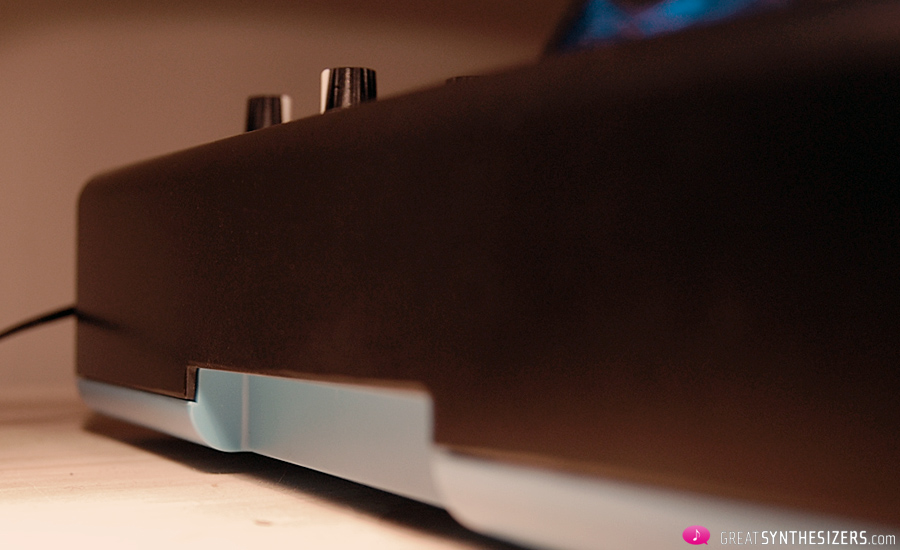
The hardware of the Bass Station II is of good quality: stable rotary knobs, reliable silver switches, sufficiently big rubber buttons (not really huuuge, but big enough) and the 25-note keyboard (a joy to play. No comparision to that silly Roland System-1 keyboard, which is a cheap construction and just awful to use). And there are hand holds … for carrying the Bass Station II around safely – a really neat feature.
All in all
We especially recommend the Bass Station II to the following users:
- Those of you with a small (fine) studio but with limited surface space looking for maximum musical output
- Those of you looking for a sovereign and capacious 2-oscillator analog synthesizer
- Those of you with a limited budget (who would appreciate a little reward now and then)
The instrument’s full-bodied analog sound and its functional layout guarantee maximum enjoyment coupled with impressive musical results. Results that cultivate intuitive music making away from complicated and elaborate setups. Back to the roots: spontaneous music making and the simple, pure enjoyment of creativity!
Enough the wise words! Listen to those 50 minutes of soundfiles below. That’s about all the information you’ll need. Let your ears be your guide. We repeat: The recordings were made with the Bass Station II alone, there are no other instruments to be heard. Occasional “stereo” soundfiles were created by mixing two Bass Station II tracks. Easy to do and surprisingly effective.
So there you have it.


Novation Bass Station II
Monophonic Analog Synthesizer
Price: approx. 499 USD / 430 Euros
(01/2023)
Website Manufacturer:
http://uk.novationmusic.com
Link / Comparison:
Novation Summit Test Report